
How to read a credit report
The seven sections of the report on real examples: what each block means, where errors and negatives hide, a client case 459 → 700+.



Hi! If you got here from my Reels, you've probably already been denied a card, a loan or a mortgage. Or you don't understand why your score isn't growing. In this guide I'll break your credit report down piece by piece — after reading it you'll be able to open your own report and understand what's wrong with it.
PART 01 · Three bureaus. Why three?
In the US your credit history is tracked by three private companies. They are competitors — each collects data itself and sells it to banks. They have no shared database. That's why your report at one bureau may look completely different from another — and that's normal.
Experian
The largest by volume of data. Headquartered in Dublin, Ireland
Equifax
The oldest, founded in 1899
In 2017 it suffered the largest breach — 147 million people
TransUnion
The youngest of the three
Often used for apartments and mobile carriers
Why is the data different? The law doesn't require banks to report to all three bureaus. One bank sends data only to Experian, another to Equifax and TransUnion, a third to all three. So Capital One may see your $5,000 debt in TransUnion, while in Equifax that entry doesn't exist at all.
Which bureau is used for what:
- Mortgage — the bank pulls all three (mortgage tri-merge) and takes the middle score
- Auto loan — most often Experian (FICO Auto Score)
- Credit cards — random; every bank has its own preferences
- Apartment rental — usually TransUnion
- Mobile / internet — Equifax or TransUnion
A 3B report = when you order all three bureaus at once. It gives the full picture. If you pull only one, you may miss negative info sitting at another bureau.
Don't confuse FICO and VantageScore — they are two different companies with their own formulas. FICO was created in 1989; VantageScore launched only in 2006 as a joint project of the three bureaus. Both run on a 300–850 range but calculate differently: FICO gives more weight to credit utilization, VantageScore to payment history. A 20–50 point gap between the two scores is normal; neither one is "lying". The key point: 90% of banks use FICO, especially for mortgages and auto loans. Credit Karma shows VantageScore — that's not a "trick", just a different model. Want to see what the bank sees? Order a 3B report with FICO scores (IdentityIQ, MyScoreIQ, MyFICO).
PART 02 · Where to order your 3B report
I work with three proven services. All three give a full 3B report + FICO scores for a small fee at the start.
SmartCredit
7-day trial · then $29.99/mo
Shows VantageScore 3.0. Convenient for disputes — there are Action Buttons right in the dashboard. Good for breaking down the report structure.
IdentityIQ
7-day trial · then $29.99/mo
Shows VantageScore. The most detailed 3B report in structure — the best visualization of collections, public records, personal info.
MyScoreIQ ★
$1 for 7 days · then $34.86/mo
The only one of the three that gives real FICO Scores from all bureaus. What banks actually see. A must-have before applying for major credit.
Which to choose
The main thing to know: SmartCredit and IdentityIQ show VantageScore, while MyScoreIQ is the only one that gives real FICO scores. This matters because 90% of banks use FICO for credit decisions. Want to see the real score the bank will see — take MyScoreIQ. If you only need to break down the report structure (negative items, inquiries, accounts) — SmartCredit or IdentityIQ will do; they have a convenient interface. The ideal scenario: connect two services — for example MyScoreIQ for scores plus IdentityIQ for breaking down the report.
Do it right now, don't put it off
Open one of the links above, sign up for a trial and order your 3B report. It takes 5 minutes. Then read the guide with your own report open next to it — that way you'll see your problems live, not in theory. Throughout the guide we analyze real examples, and you'll compare them with what's in your report. It's 10 times more effective than just reading.
- What you get with the subscription
Fraud insurance up to $1,000,000 — if someone takes out credit or a loan in your name or steals money, the insurer covers lawyers, document recovery and personal expenses for restoring your identity
Alerts on any activity — every time someone makes a hard inquiry, opens a new account, changes an address or makes a transaction in your name, you get a push/email instantly
Dark Web monitoring — the service scans the dark side of the internet and hacker forums. If your SSN, email, card number or passwords show up in leaks, you're the first to know and have time to react
Monitoring of all 3 bureaus 24/7 — any changes in your credit report (new accounts, late payments, collections) arrive as a notification, no need to log in and check by hand every time
SSN tracking — monitoring the use of your Social Security Number in US public databases
FICO Score Simulator — shows what will happen to your score if you pay off a debt, close a card or take out new credit. Before you do it.
PART 03 · Going through the report section by section
When you open your 3B report, you'll see seven main sections. Let's go through each one — using the example of a real report from IdentityIQ.
3.1 Customer Statement & Fraud Alerts
Your report starts with this section — and 99% of people skip it. That's a mistake. This is where the statements and alerts that you or someone else added to the report are stored. The most common and dangerous type is the FCRA Fraud Alert.
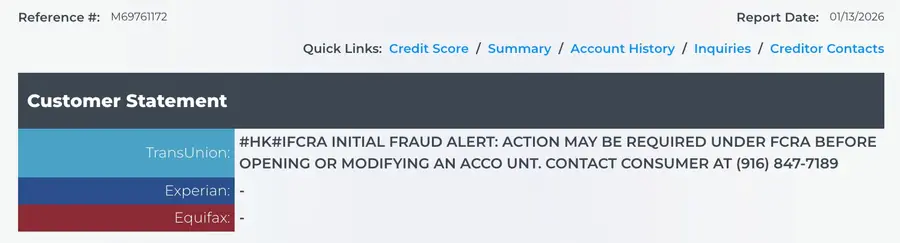
What do you see in the example above? The client has an Initial Fraud Alert at TransUnion. This is a special warning that forces the bank to CALL the person back before approving any new credit. Experian and Equifax are empty (a dash), which means the alert is only at one bureau.
When it's useful:
- You've been robbed or your SSN was stolen — you set a Fraud Alert and the fraudster can't open credit without a call to you
- You appeared in a breach (Equifax 2017, T-Mobile, AT&T, etc.) — preventive protection
- Lost your documents or had your wallet stolen
When it's a PROBLEM:
- Someone placed a Fraud Alert on your report without your knowledge (often happens after bank fraud)
- You set it yourself a few years ago and forgot — now banks call the old number and can't reach you → denial
- The alert is only at one bureau (as in the example) — a bank that pulls that bureau will slow down or deny the credit
What to look for in this section
Any text you didn't add yourself. If there's something written in Customer Statement, remember whether you did it. If not, it's either a bureau error or someone else's hands in your report. It's also important to check the phone number in the alert — if it's old or not yours at all, the bank won't be able to reach you when trying to approve credit, and you'll get unexplained denials. Many people spend months not understanding why they're being denied — and the reason is right here.
This section may contain several types of entries, and each affects your credit differently:
- Initial Fraud Alert — valid for 1 year. The bank must call you back before opening new credit.
- Extended Fraud Alert — valid for 7 years, placed only for victims of actual identity theft.
- Active Duty Alert — for military personnel on deployment.
- Credit Freeze — completely blocks the report. No bank can pull it. This is the strictest form of protection.
- Consumer Statement — your personal statement attached to the report (e.g. "I dispute account XYZ"); all banks see it.
Each such entry affects credit approval. If you have a Freeze, no application will go through — the bank will see "no record". If you have a Fraud Alert, the application will take a long time or involve additional checks. Many don't even suspect they have something set — alerts can remain from past years, be placed automatically after data breaches, or appear by mistake.
3.2 Personal Information
This is your personal data — name, date of birth, current and previous addresses, employers. The most underrated section. 70% of people don't even look at it, and that's a mistake — this is where errors and traces of identity theft most often hide.
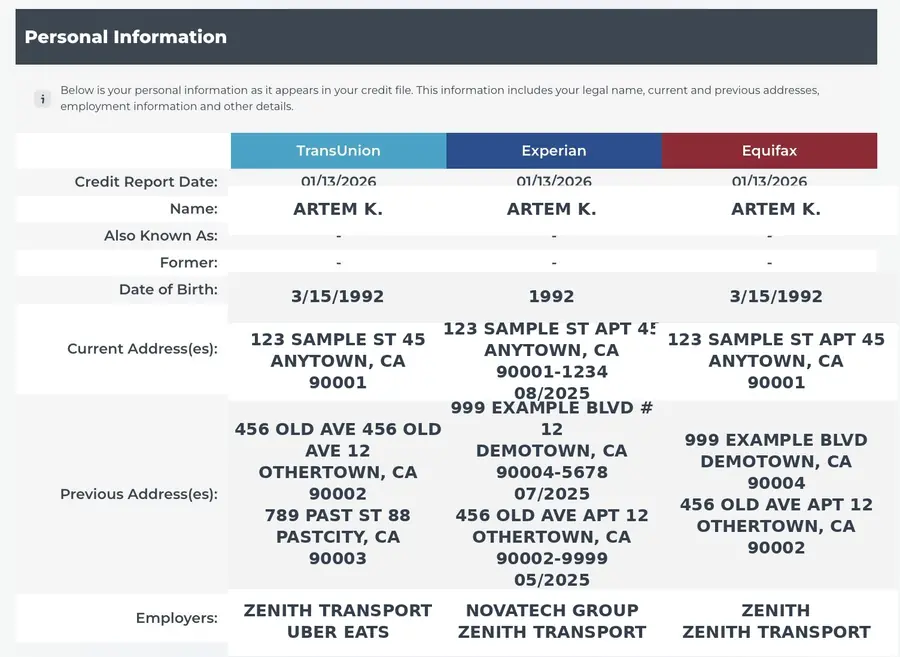
What to pay attention to
- 1. Name and Also Known As. If one of the bureaus has your name misspelled, or there's someone else's "Also Known As", that's a serious red flag. Banks check the name and may deny or require additional documents. Someone else's name in Also Known As may be a trace of identity theft or a mix-up with a namesake — such entries need to be removed.
- 2. Addresses where you never lived. An address you can't explain is the most dangerous find in this section. It may be a leftover from identity theft (a fraudster opened credit in your name at their address) or a bureau error. The bank sees a "strange" address → raises a risk flag → denial or a higher rate.
- 3. Duplicate entries. The same employer or address recorded twice (like "ZENITH" and "ZENITH TRANSPORT" at Equifax above) — it's not critical for the score, but it clutters the report. It's worth cleaning up so the profile looks tidy.
4. Employers like Uber, DoorDash, Lyft, Instacart. This is a huge pitfall for immigrants. Many do gig-economy side work and don't realize these employers stay in the report. When you apply for an auto lease, the bank sees "Uber Eats" among your employers and thinks: "this person will use the car for delivery/rideshare". Lease programs prohibit this, so you either get denied or offered a commercial program at a much higher rate. The same goes for a mortgage — banks consider 1099 income through apps unstable.
Most people don't know what's in their Personal Information. Yet this is exactly the section where a bank starts its check — and what's written there shapes the first impression of you as a client.
3.3 Credit Score
The most "stressful" section of the report — here you see your three scores from the three bureaus. It's the first thing a bank looks at when evaluating your application.
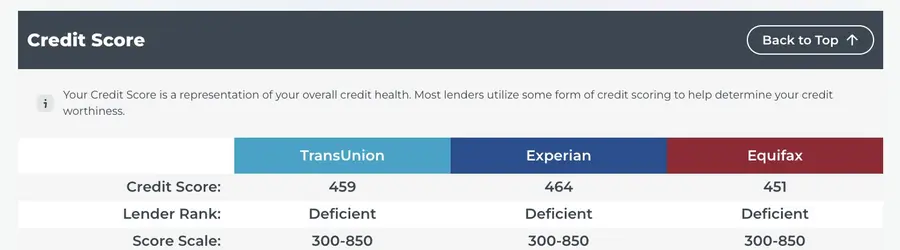
In the example above the client has three low scores — TransUnion 459, Experian 464, Equifax 451. All three are marked "Deficient", which means that for most banks and credit cards the person practically doesn't exist. Applying for any credit will almost always end in a denial, or an offer of a program at an insane interest rate.
FICO Score Ranges — what the numbers mean:
- 300–579 Poor / Deficient — denials practically everywhere
- 580–669 Fair — approved with a high rate and a low limit
- 670–739 Good — standard terms
- 740–799 Very Good — the best terms
- 800–850 Exceptional — premium products, the lowest rates
What to pay attention to
- 1. The difference between bureaus. In the example above the gap between Experian (464) and Equifax (451) is only 13 points, which is normal. But if the gap between bureaus is 50+ points, there's a negative sitting in one bureau that the others don't have. For example, a late payment landed only in TransUnion, or a collection only in Equifax. That's the first lead for the work — you need to dig in and find what's wrong.
- 2. "Deficient" / "Poor" status. This is the category below 580 — the most painful one. At this score banks physically cannot approve most products: mortgages, auto leases, premium cards — all closed. Only secured cards (cards against a deposit) and subprime loans at 24%+ per year are available.
- 3. Which score the bank actually looks at. The number in the report is not the final verdict. Each bank uses its own FICO model: FICO Auto Score (250–900) for auto, FICO 2/4/5 for mortgages, FICO 8 or 9 for cards. The same person can have FICO 8 = 680 and FICO Auto Score = 720. So the score in IdentityIQ is a reference point, and the bank will see the real picture for a specific type of credit itself.
The score is a consequence, not a cause. Seeing a low score and trying to "raise the score" directly is working backwards. The score rises automatically when the report is cleaned up: late payments, collections and unnecessary inquiries are removed, utilization is evened out. So the main focus should not be on the number but on what shapes it — the sections below (Accounts, Inquiries, Collections).
3.4 Risk Factors
This section shows why your score is exactly what it is and not higher. The bureau analyzes your report and lists the factors pulling the score down. Essentially it's a ready-made roadmap of what to fix first.
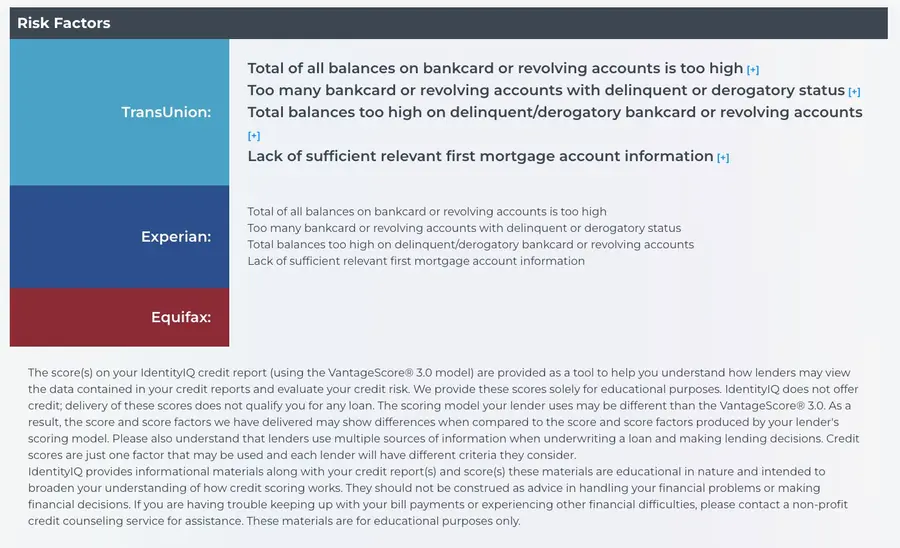
In the example above, the client's TransUnion and Experian show the same problems:
- "Total of all balances on bankcard or revolving accounts is too high" — total credit card debt is too high
- "Too many bankcard or revolving accounts with delinquent or derogatory status" — too many cards with late payments or a negative status
- "Total balances too high on delinquent/derogatory bankcard or revolving accounts" — large balances specifically on problem cards
- "Lack of sufficient relevant first mortgage account information" — no mortgage in the report (banks like a mix of credit types)
What to pay attention to
- 1. Each Risk Factor is a specific problem with the score. The bureau doesn't write this for nothing — it states directly what is stopping the score from growing. If the first line says "balances too high", your utilization is above 30% and needs to come down. If it says "delinquent or derogatory status", there are accounts with late payments or charge-offs that need cleaning up.
- 2. Compare the factors between bureaus. If TransUnion has 4 factors and Equifax only 1, there's more negative info sitting at TransUnion. This often happens when a creditor reports to only one bureau.
- 3. "Lack of sufficient first mortgage account information" — that's normal if you have no mortgage. It's not a critical factor, but the score won't reach 800+ without a mortgage or auto loan in your history.
- 4. If you have a VantageScore (not FICO). In the screenshot below IdentityIQ warns that it shows VantageScore 3.0. This is an educational model — banks more often use FICO. The score and factors in FICO may differ.
Risk Factors is the most valuable part of the report for building a strategy. Many spend months trying to "raise the score" without understanding what exactly is pulling it down. And the answer is always here — the bureau itself writes you the diagnosis. An experienced specialist builds an action plan from this list in 5 minutes: what to clean up, in what order, what effect to expect.
3.5 Summary
Here are the overall statistics of your report in numbers. At a glance you see the scale: how many accounts you have, how much debt, how many late payments, how many inquiries in the last 2 years.
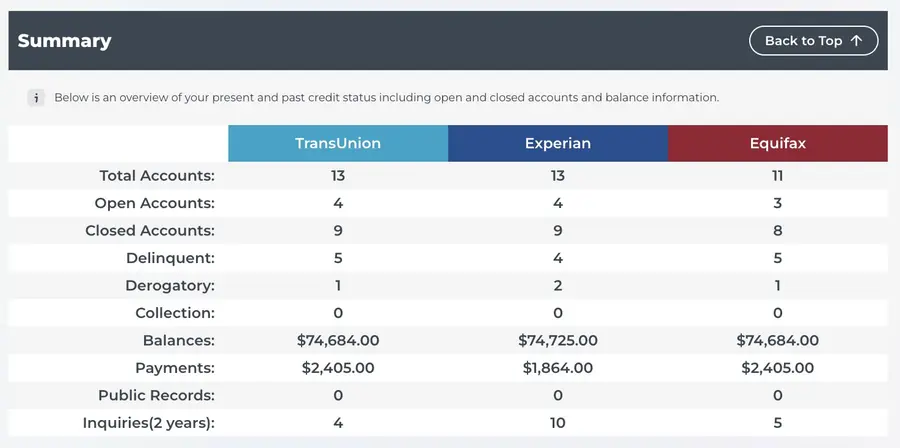
In the example above the client has:
- 13 accounts at TransUnion and Experian, but only 11 at Equifax — a 2-account discrepancy
- 4 open, 9 closed — most are no longer active
- 5 Delinquent + 1 Derogatory at TransUnion — that's a lot of negative info
- $74,684 total balance — serious debt
- 10 Inquiries at Experian vs 4 at TransUnion — banks were actively checking Experian in particular
What to pay attention to
- 1. A mismatch in the number of accounts between bureaus. In the example above TransUnion and Experian see 13 accounts, while Equifax sees only 11. That means 2 creditors don't report to Equifax. Not critical, but interesting — for example, if you have positive accounts missing from one bureau, your score there will be lower.
- 2. Delinquent vs Derogatory. Delinquent is a late payment that can still be fixed. Derogatory is already a serious negative (charge-off, collection, bankruptcy). In the example, 5 delinquent + 1 derogatory means 1 account is already "gone" — the bank wrote off the debt.
- 3. The ratio of Inquiries between bureaus. 10 inquiries at Experian vs 4 at TransUnion means the person applied to banks that mostly checked Experian. Each inquiry lowers the score by 2–5 points and lives in the report for 2 years.
Summary is your report in one picture. When I look at someone's report for the first time, I start with this page. From the numbers I already understand the strategy: many inquiries → a 6-month pause. A high balance → a plan to lower utilization. Several delinquent → payment discipline. Only then do I go into the details.
3.6 Account History (Tradelines)
The biggest section of the report. Here is every one of your accounts — open, closed, charge-offs, auto loans, mortgage, credit cards — with all the details: limit, balance, month-by-month payment history for 2 years.
Let's go through 5 typical scenarios you'll see in your report:
- Example 1: A good account (Current)
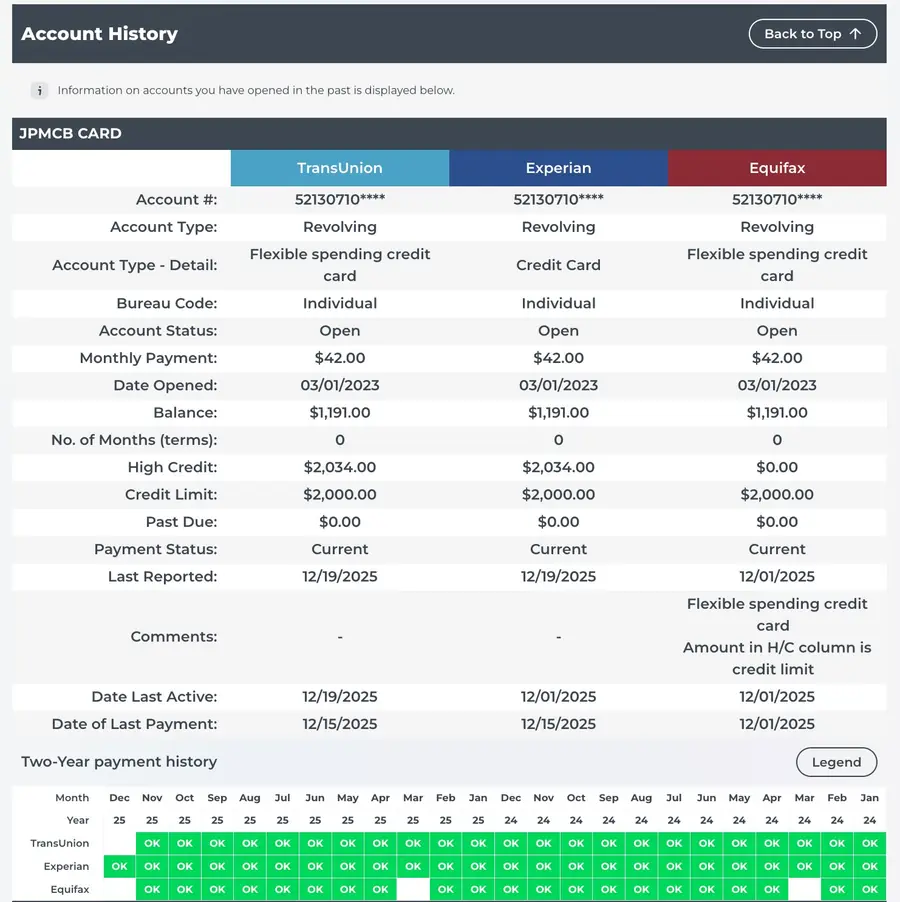
JPMCB Card — an open revolving card with a $1,191 balance on a $2,000 limit. Payment Status: Current, the payment history is solid green "OK". This is a model account. BUT: utilization here is 60% ($1191/$2000) — that's a lot; ideally keep it below 30%.
- Example 2: A bad account (Late 120 Days)
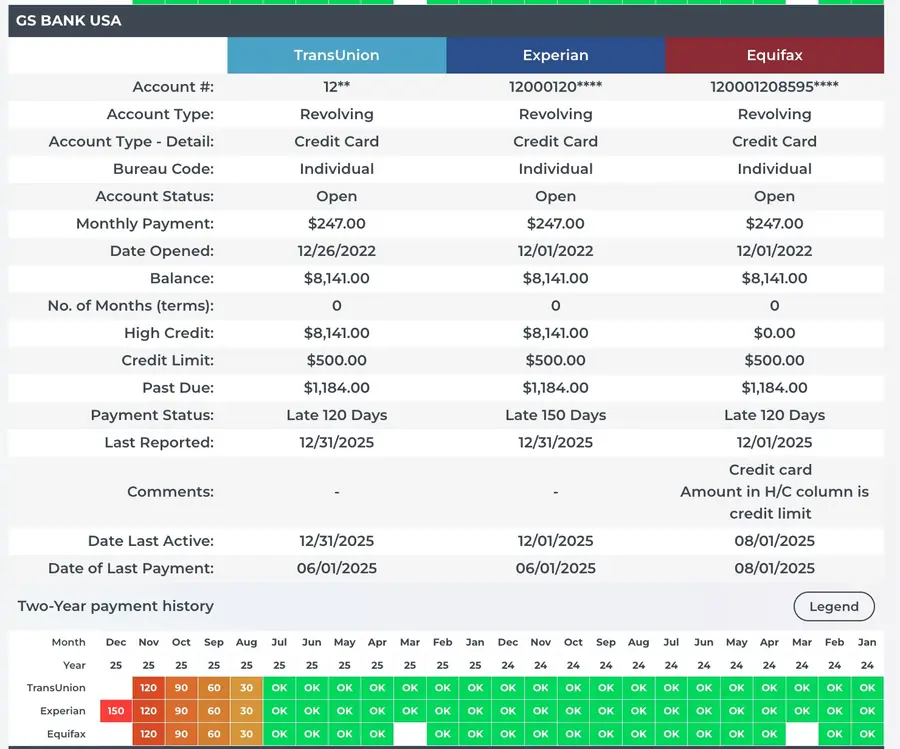
GS Bank USA — a card with a limit of only $500, but a balance already at $8,141 (16 times over — that's penalties and interest). Late 120/150 Days. Payment history: OK since August, then 30 → 60 → 90 → 120 → 150 (Experian). This is the classic "stopped paying six months ago" picture. Minus 100+ points.
- Example 3: A tradeline service (junk that needs to be removed)
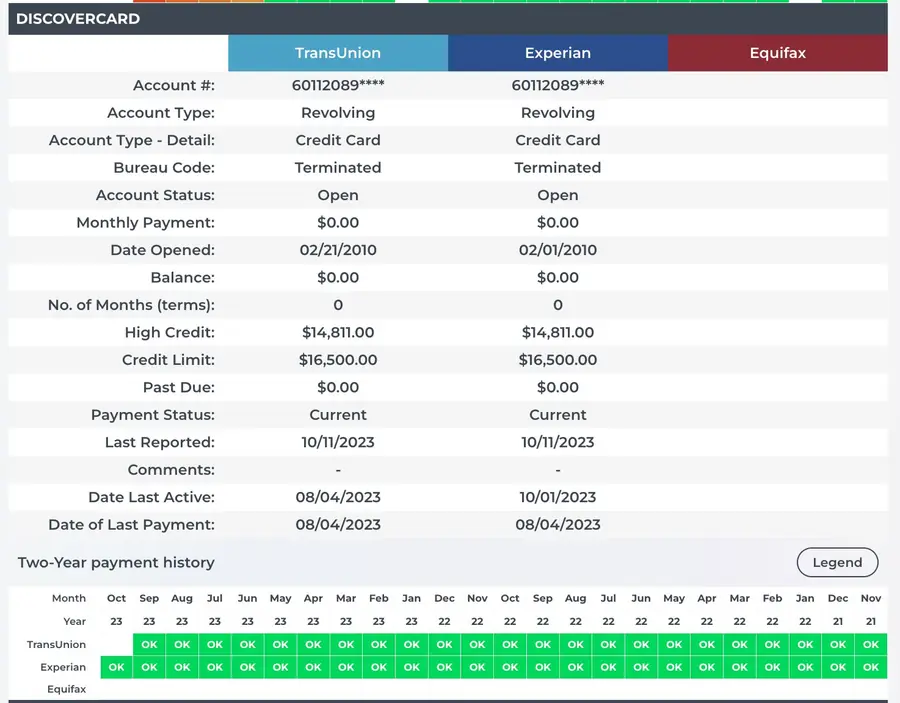
At first glance it's a great card: opened in 2010, a $16,500 limit, a perfect payment history. But look closely: Bureau Code: Terminated, plus this entry exists only in TransUnion and Experian and is missing from Equifax entirely. This is not really your card — it's a tradeline service like Credit Boost, Boost Credit, Self or Kikoff. Such services add you as an authorized user to an old card with a good history. When payments for the service stop, the entry is marked Terminated and stays in your report as clutter. Many think "whatever, the limit is big and the history is long — let it be". That's a mistake. Banks see a terminated entry, and it no longer helps your profile. Such entries are better disputed so the report looks clean and current.
- Example 4: Auto Lease (Installment) (Installment)
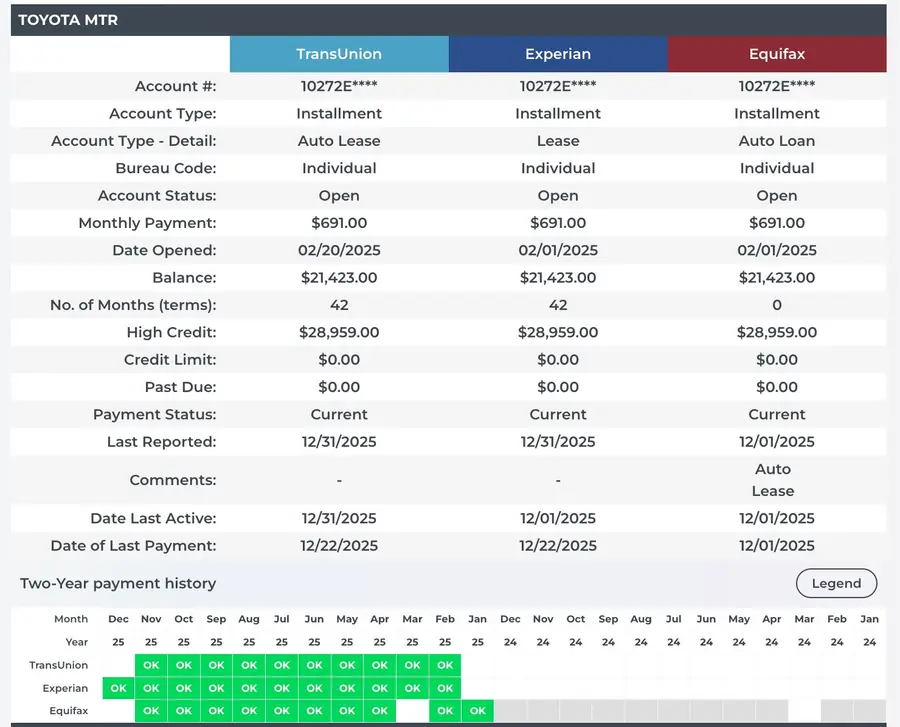
Toyota Motor — an auto lease opened in February 2025, $21,423 balance over 42 months, $691 monthly payment. Account Type: Installment (as opposed to Revolving for cards). Current, all payments OK. Installment accounts help build your credit mix — banks like to see different types of credit (cards + auto + mortgage).
- Example 5: Charge-off / Collection / Collection (the harshest)
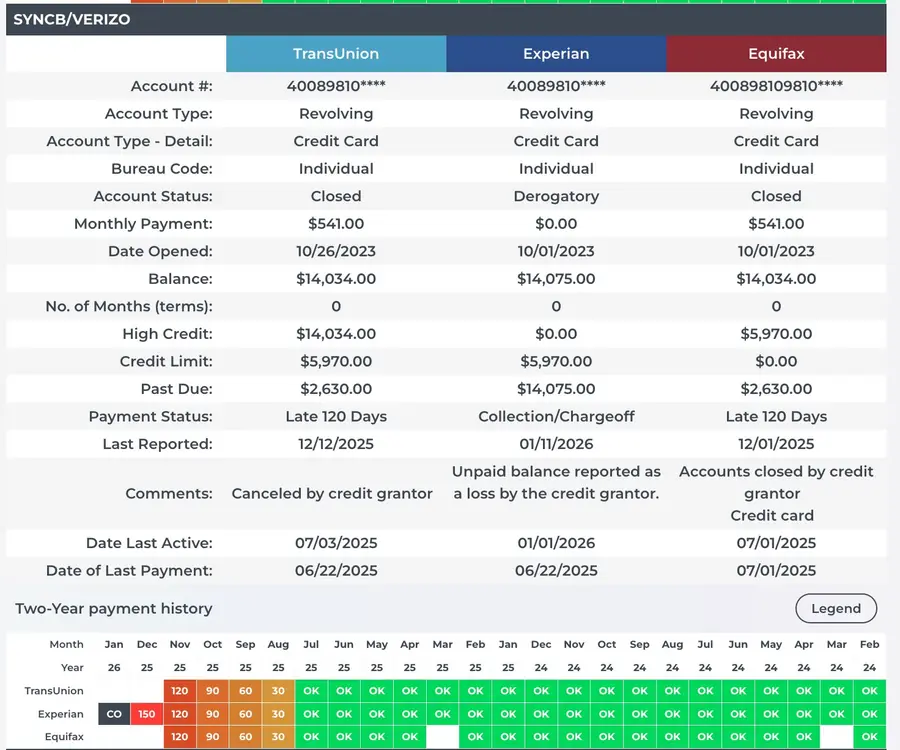
SYNCB/Verizon — a Synchrony Bank/Verizon card opened in October 2023. Balance $14,034 against a $5,970 limit. Status: Closed/Derogatory, Collection/Chargeoff. History: everything was OK, then sharply 30 → 60 → 90 → 120 → CO (Charge-off). Comment: "Unpaid balance reported as a loss by the credit grantor". This means the bank wrote the debt off as a loss. Minus 100–150 points and a mark in the report for 7 years.
What to pay attention to
- 1. Payment Status is the main field. Current = all good. Late 30/60/90/120/150 — escalating delinquency; the more days, the bigger the hit to the score. Charge-off / Collection — the bank wrote off the debt.
- 2. Two-Year payment history (the squares). Green OK = good. Yellow/orange/red numbers = late payments. Black CO = charge-off. Gray squares = the bureau didn't receive data for that month (that's not bad).
- 3. Discrepancies between bureaus. Often the same account looks different at the three bureaus — for example, GS Bank USA shows Late 120 at TU/EQ but Late 150 at Experian. That means Experian received more recent data.
4. Tradeline services and authorized users. If your report has an account like example 3 (old, perfect, marked Terminated, only in one or two bureaus), it's most likely a trace of a tradeline service that was no longer paid for. Such terminated entries need to be cleaned up, while an active authorized user line, on the contrary, works for your profile. Your genuinely old cards (the ones you opened and used yourself) — don't close them, they hold up your Average Age of Accounts.
- 5. Utilization (use of the limit). Calculated as: balance / credit limit × 100%. Ideally keep it below 10%, up to 30% is fine. JPMCB is above 60% — that already lowers the score.
Account History is the heart of the report. 65% of your score lives here (35% Payment History + 30% Amounts Owed). One charge-off like the SYNCB/Verizon one can kill your score by 100+ points and shut the door to most banks. On the other hand, one real, old, clean card (your own, not a tradeline service) can keep you in the Good category even when the rest is so-so. Every account here is either an asset or a liability for your credit history.
3.7 Inquiries
Every time you apply for credit, the bank makes a hard inquiry — a request to the bureau. These inquiries stay in the report for 2 years and lower the score by 2–5 points each.
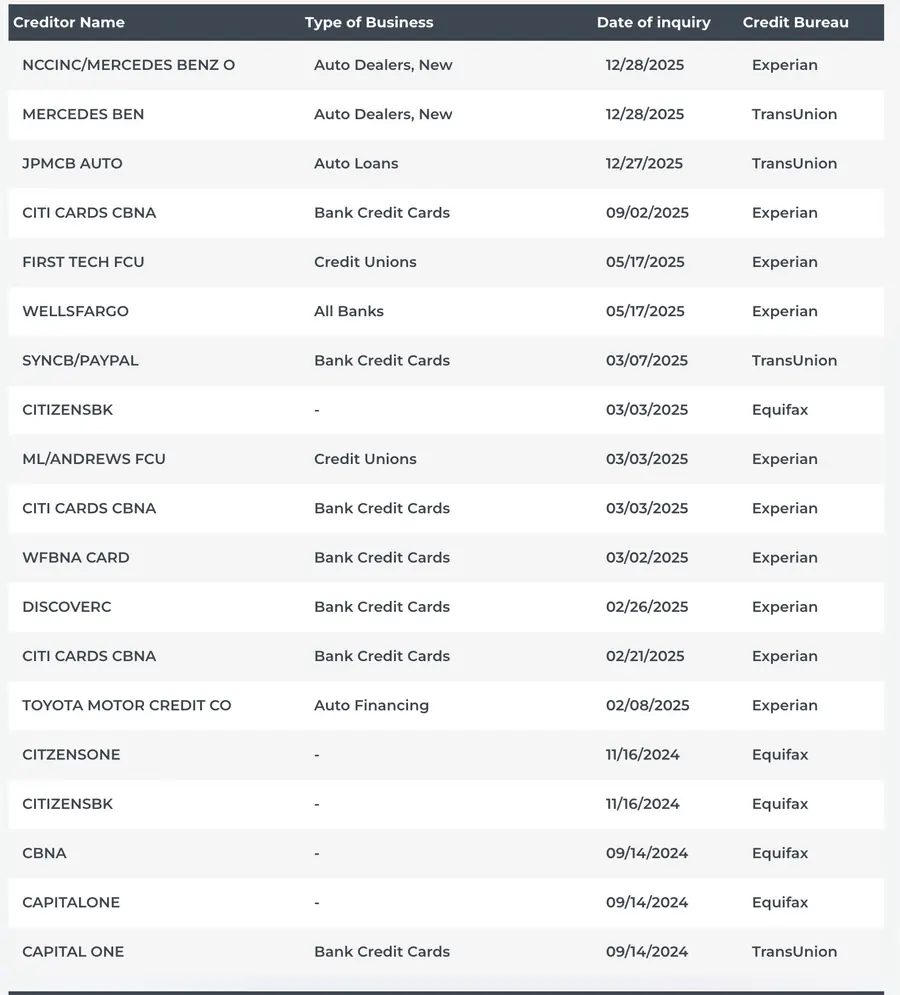
The example above shows the classic picture of a report overloaded with inquiries:
- December 2025: NCCINC/MERCEDES BENZ + MERCEDES BEN + JPMCB AUTO — three inquiries in a row; the person was clearly applying to buy a Mercedes
- February–March 2025: CITI CARDS (3 times!) + DISCOVER + WFBNA + SYNCB/PAYPAL — a series of card applications
- May 2025: FIRST TECH FCU + WELLSFARGO on the same day — applied to a credit union and a bank at the same time
What to pay attention to
- 1. Clustered inquiries. If you have 5+ hard inquiries in 6 months, it's a red flag for banks. They think: "this person is urgently looking for money, something is wrong". And they deny, even if the score is fine. In the example above the client has a whole series of inquiries in a row — a signal of financial trouble.
- 2. Duplicate inquiries. See "CITI CARDS CBNA" three times — 09/02, 03/03 and 02/21? That means the person applied to Citi 3 times (or once, and Citi checked them several times). Each check = -2 to 5 points.
- 3. Auto Inquiries are a special case. When you apply at a dealership, the dealer often "shops" your credit to 5–10 banks at once — each one does a hard inquiry. Under the FICO rule all auto inquiries within 14–45 days count as one. But many immigrants don't know this and agree to ten checks in a row.
- 4. Inquiries at only one bureau. In the example: 12 inquiries at Experian, 4 at TransUnion, 5 at Equifax. That means banks check Experian more often — and that's exactly where this client's lowest score will take longer to recover.
- 5. Hard vs Soft. This section only has hard inquiries — the ones you initiated yourself by applying. Soft inquiries (pre-approved offers, your own score checks) do NOT affect the score and usually aren't shown in this section.
The most common immigrant mistake: "I didn't get the card, I'll try one more bank. Still didn't get it — I'll try a third one". By the fifth denial the score is already down 25 points from inquiries, plus banks see a string of denials and stop — they deny automatically. Don't apply "for luck". First check your report, understand what's wrong with it, fix it — then apply to one carefully chosen bank that fits your profile.
GOOD TO KNOW · All of this can be disputed
Now that you've figured out the sections and seen real examples, the main question is — can anything be done about it? The short answer: yes, and most of the negative can be removed entirely.
What can be disputed in a report
Late payments (30/60/90/120 days) — even if they really happened
Charge-offs — debts written off by the bank
Collections — debts sold to collectors
Hard inquiries after which you did NOT open an account — the bank checked you, denied you, and the hit to the score stayed for 2 years
Tradeline services with Terminated status (Credit Boost, Self, Kikoff and similar)
Duplicate accounts — when the same debt is recorded twice
Inaccurate addresses, names, employers in Personal Information
Public Records — court judgments, tax liens
Old fraud alerts you forgot about that get in the way of approvals
Bankruptcy — in some cases
This works under the federal FCRA (Fair Credit Reporting Act) — it requires the bureaus to remove any information the creditor cannot fully confirm with documents. In practice the bureaus remove 30–60% of disputed negatives simply because creditors often don't have a complete set of documents or don't respond in time.
- It's just important to understand
It's not magic and it doesn't disappear on its own. Each account is disputed separately — you need to state the reason correctly, send letters to all three bureaus, wait for the response, and if refused, file a repeat dispute on a different basis, use the FDCPA against collectors, debt validation against the original creditor, and so on. One person can spend 6–12 months on this and get no result. A professional does the same in 2–4 months, because they know exactly which wording works, which bureaucratic loopholes to use, and in what order to approach each bureau.
The most underrated item: hard inquiries with no account opened. You applied for a card → got denied → minus points for 2 years. Most people don't even suspect these inquiries can be removed. Under the FCRA, if you did not give written permission for that specific check, or if the check did not result in an account being opened, the inquiry can be disputed as "unverified". Each removed inquiry = +2–5 points. For a client with 12 inquiries this easily gives +30–50 points just from cleaning up this section.
REAL CASE · What it was vs what it became
Remember the screenshots from Part 3, where we went through a report with a $14,034 charge-off (SYNCB/Verizon), Late 120/150 Days (GS Bank), a pile of delinquent accounts and $74,684 in total debt? That's a real Excalibur Credit Solutions client. Here's what happened: 3 months to clean up and prepare the profile + 2 weeks to approval and delivery of the car:
Starting score
459 / 464 / 451
Deficient at all 3 bureaus
After 3.5 months
700+
Good category
What was done
- All negatives removed from the report (charge-off, late payments, collections)
- Extra hard inquiries cleared
- A credit boost was done — quality tradelines added
- Financed: a 2022 Mercedes-Benz GLE 63 S AMG
- 2 new credit cards opened with limits of $35,000 and $5,000
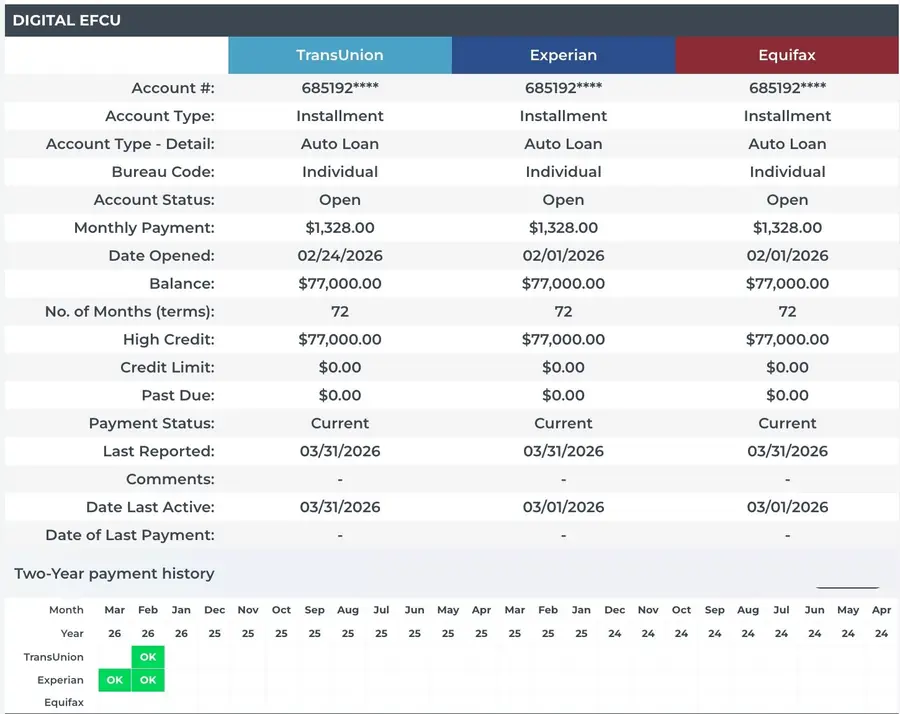
- Mercedes-Benz GLE 63 S AMG (2022) — financing
An auto loan for $77,000 over 72 months, monthly payment $1,328, status Current. After 3 months of work on the report the client applied to the bank, and in ~2 weeks got approved and drove out of the dealership in the car.
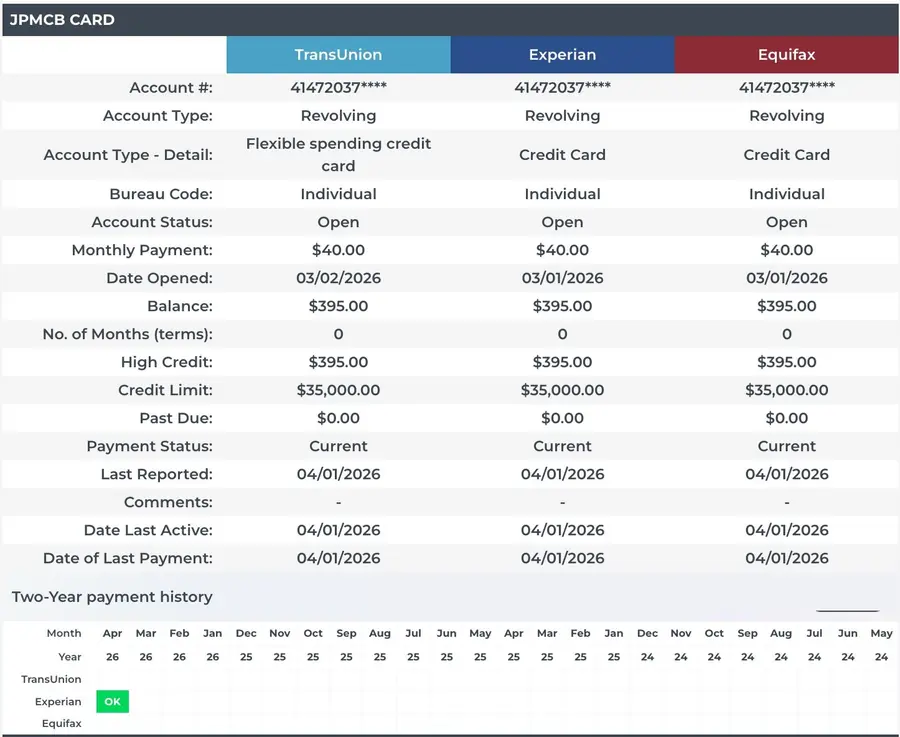
- JPMCB Card — $35,000 limit
A premium Chase credit card with a $35,000 limit. That's the level of people with a 740+ score. Approved in parallel with the auto loan — banks saw a clean report and started issuing credit on their own.
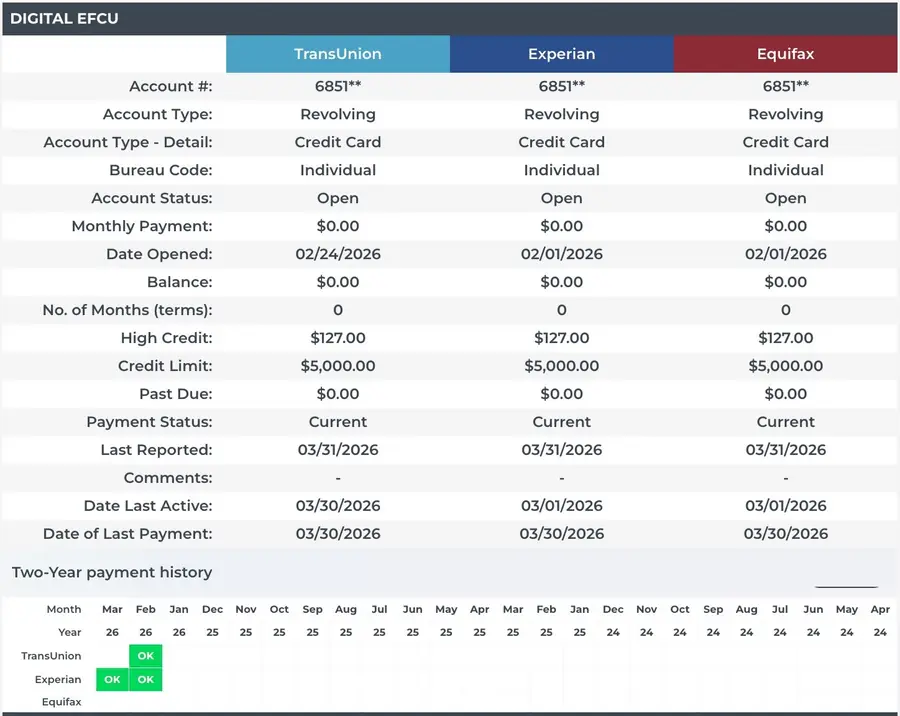
- Digital EFCU — $5,000 limit
An additional credit card from Digital Federal Credit Union with a $5,000 limit for credit mix and lowering overall utilization.
What this means for you
This client came to Excalibur Credit Solutions with the same problems you may be seeing in your report right now — charge-offs, late payments, bank denials. In 3.5 months (3 months to clean the profile + 2 weeks to approval) his life changed: the negatives were removed, the score was rebuilt, and instead of denials — a 2022 Mercedes GLE 63 S AMG and cards with serious limits.
It's not magic and not marketing. It's systematic work: disputing negatives under the FCRA, removing inquiries, a well-planned credit boost, and targeted applications to the right banks at the right moment. You can't replicate this on your own — you need experience, an understanding of the system and access to the right tools.
PART 04 · Review checklist
Once you've ordered your 3B report, go down this list and tick off each item:
What to check in the report
Compare the three FICO scores — find where the gap is 50+ points
Check Personal Information — are there unfamiliar addresses/employers
Find all hard inquiries — mark those where you didn't apply
Check every account — are they all really yours
Find all late payments — write down dates and amounts
Find all collections — write down the original creditor
Check charge-offs — compare the dates with late payments
Calculate the utilization rate (balance / limit) for your cards
Check Public Records — bankruptcies, court judgments
Check account opening dates — are there any you didn't open