Which language is most comfortable for reading and talking to us?
Knowledge basefree · in English · written by our managers
Articles about credit in the US from people who dispute with the bureaus every day
How to read the report, what can be disputed, how to get a card, an auto loan, a mortgage and business financing. No fluff and no promises: only what works under the law.
Start with this
How to read a credit report in 20 minutes
What each block of the report means, where errors hide and which five things to check first. The same checklist is given to people on the Excalibur Credit University waiting list.
Guides the team wrote for clients: breaking down a credit report, cards and pre-approval, banks for an account, Amex, Robinhood, SSN protection. Everything is based on our experience and our clients' results; this is not legal or financial advice, and every case is individual. Read right on the site
How to find out the same day and not pay someone else's debt: SmartCredit, 15 minutes to set up.
2 minutesInstructions
To open a card or a loan in your name, a fraudster only needs your Social Security number and date of birth. Your Social has almost certainly been in data breaches already. Someone else's debt will appear on your report silently, and you will learn about it a year later, when a collector calls.
A real case of our client
He came to review his report before a car loan. We open it together: an $11,400 credit card opened in another state, a Planet Fitness membership with a collection for a year of non-payment, and a $24,000 medical debt for treatment he never had. A total of $37,000 in someone else's debts, a 540 score and a bank denial. In two years he did not get a single letter: everything went to the fraudster's address. We are still sorting it out.
The solution: SmartCredit
Three-bureau monitoring: an alert on your phone the day someone applies in your name, one call to the bank, and there is no debt. Plus $1,000,000 identity theft insurance. About $30 a month. It is the same report we ask for when we do a free review.
Sign-up. Use the button above: name, address, e-mail, Social, date of birth, card for payment.
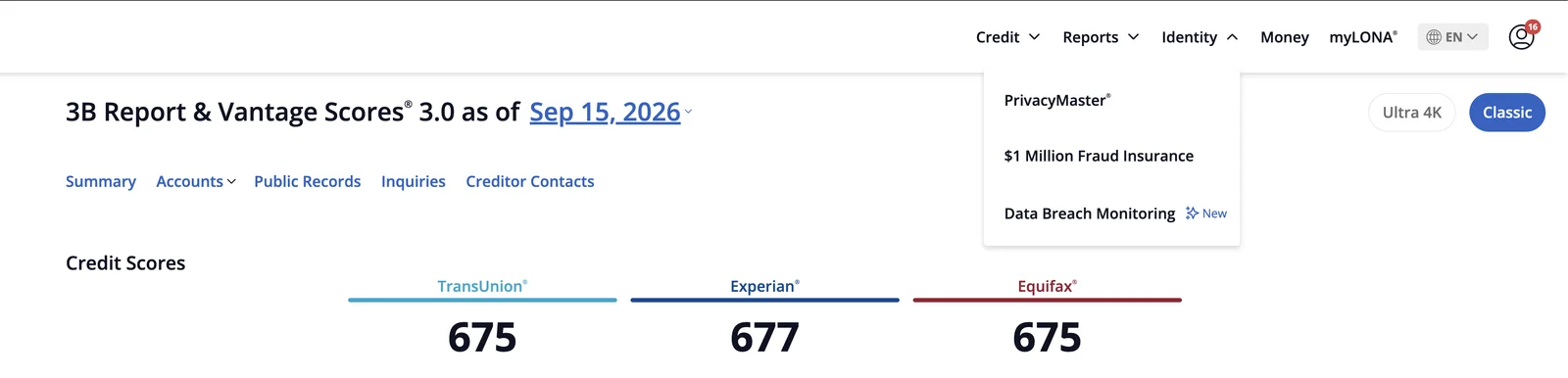
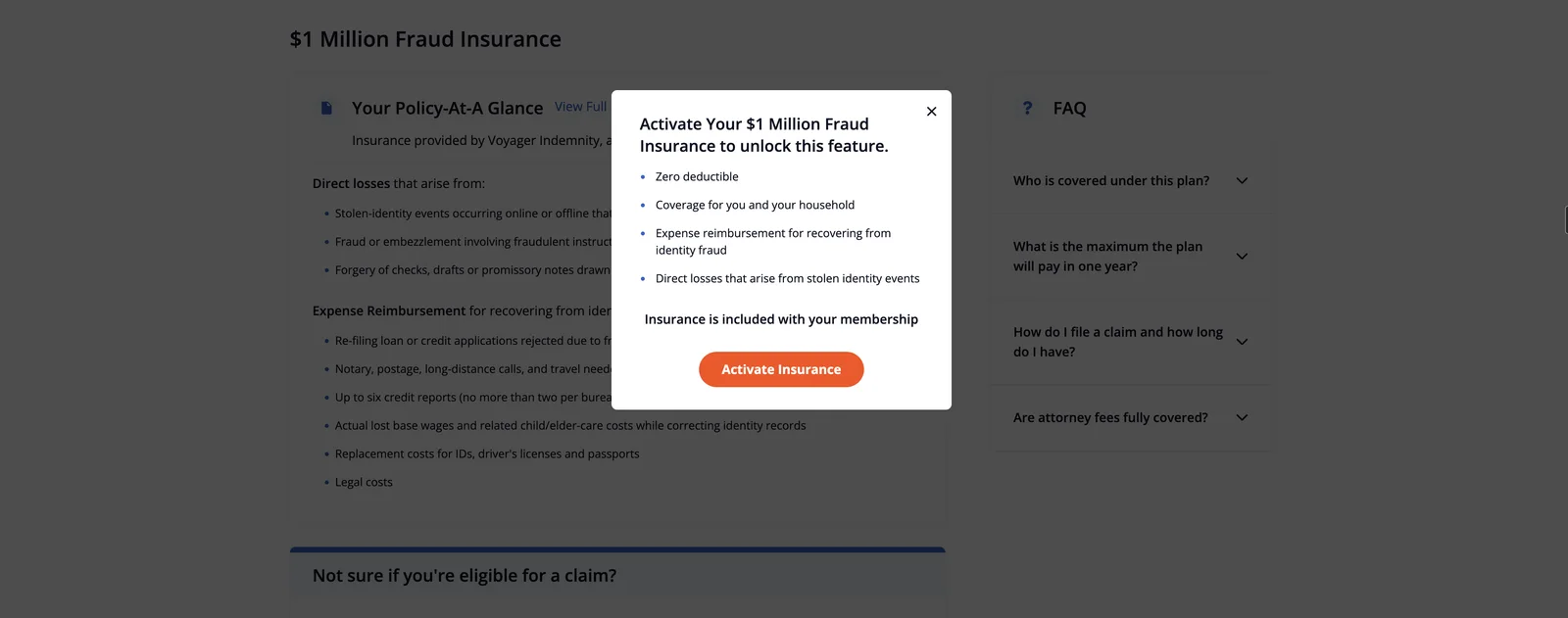
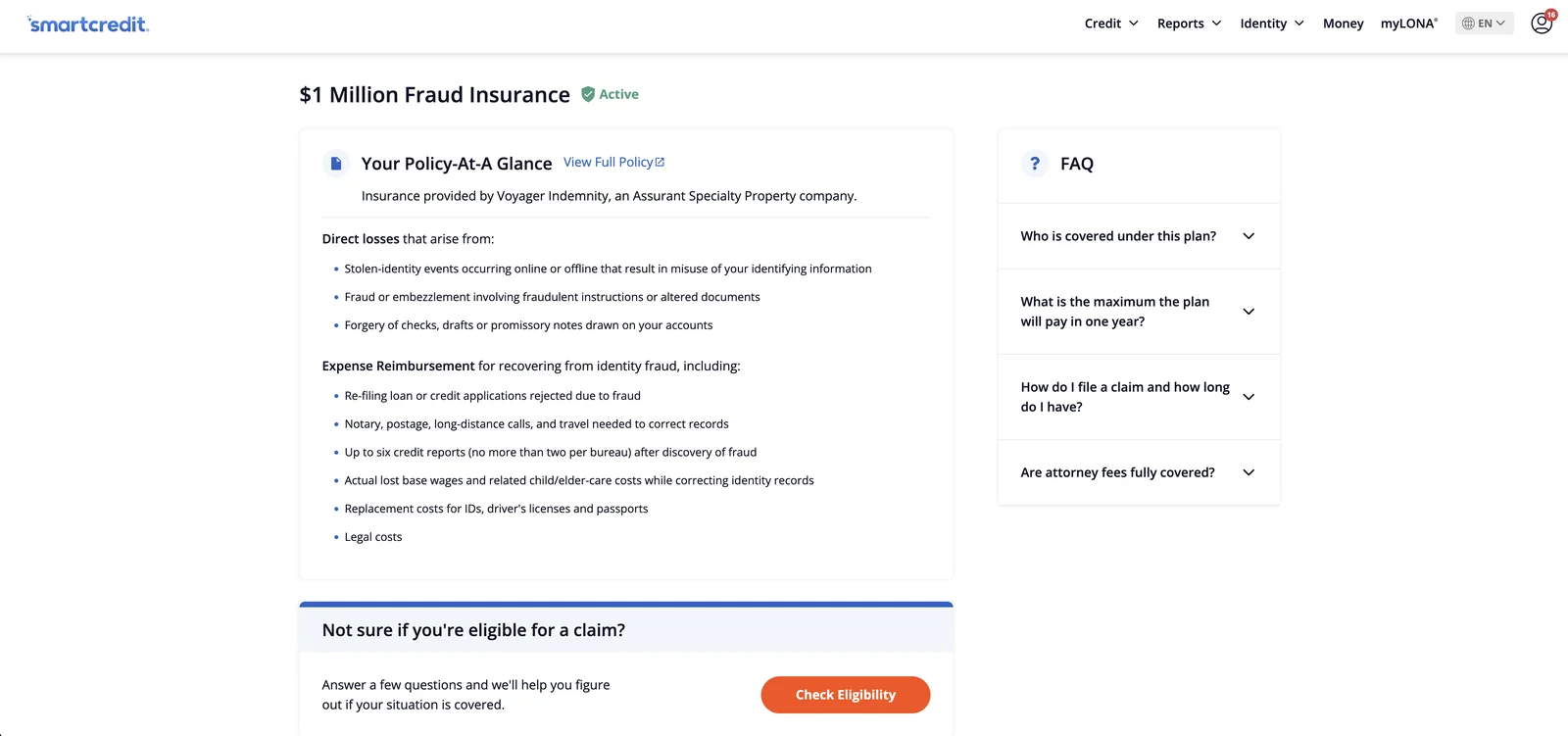
Insurance. In the Identity menu open $1 Million Fraud Insurance and press Activate Insurance: the insurance is included in the subscription but is switched on with a button. After that the status shows Active.
Notifications. In Alerts turn on push and e-mail.
The report to us. Download the three-bureau report and send it to a manager. The review is free.
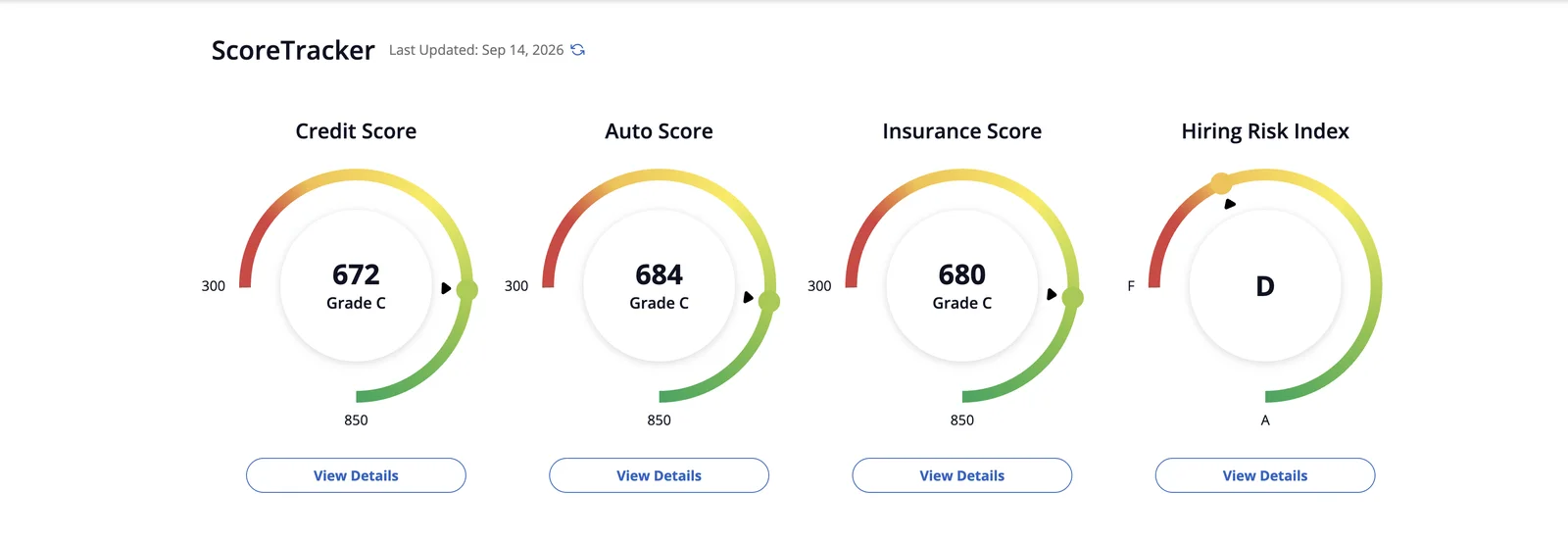
SmartCredit home screen: scores from all three bureausIdentity menu → $1 Million Fraud InsuranceThe Activate Insurance button: the insurance is switched on with one tapStatus Active: the $1,000,000 insurance is onBonus: data breach and dark web monitoring is on
The seven sections of the report on real examples: what each block means, where errors and negatives hide, a client case 459 → 700+.
25 minutesFull guide
Hi! If you got here from my Reels, you've probably already been denied a card, a loan or a mortgage. Or you don't understand why your score isn't growing. In this guide I'll break your credit report down piece by piece — after reading it you'll be able to open your own report and understand what's wrong with it.
PART 01 · Three bureaus. Why three?
In the US your credit history is tracked by three private companies. They are competitors — each collects data itself and sells it to banks. They have no shared database. That's why your report at one bureau may look completely different from another — and that's normal.
Experian
The largest by volume of data. Headquartered in Dublin, Ireland
Equifax
The oldest, founded in 1899
In 2017 it suffered the largest breach — 147 million people
TransUnion
The youngest of the three
Often used for apartments and mobile carriers
Why is the data different? The law doesn't require banks to report to all three bureaus. One bank sends data only to Experian, another to Equifax and TransUnion, a third to all three. So Capital One may see your $5,000 debt in TransUnion, while in Equifax that entry doesn't exist at all.
Which bureau is used for what:
Mortgage — the bank pulls all three (mortgage tri-merge) and takes the middle score
Auto loan — most often Experian (FICO Auto Score)
Credit cards — random; every bank has its own preferences
Apartment rental — usually TransUnion
Mobile / internet — Equifax or TransUnion
A 3B report = when you order all three bureaus at once. It gives the full picture. If you pull only one, you may miss negative info sitting at another bureau.
Inside info from Excalibur Credit Solutions
Don't confuse FICO and VantageScore — they are two different companies with their own formulas. FICO was created in 1989; VantageScore launched only in 2006 as a joint project of the three bureaus. Both run on a 300–850 range but calculate differently: FICO gives more weight to credit utilization, VantageScore to payment history. A 20–50 point gap between the two scores is normal; neither one is "lying". The key point: 90% of banks use FICO, especially for mortgages and auto loans. Credit Karma shows VantageScore — that's not a "trick", just a different model. Want to see what the bank sees? Order a 3B report with FICO scores (IdentityIQ, MyScoreIQ, MyFICO).
PART 02 · Where to order your 3B report
I work with three proven services. All three give a full 3B report + FICO scores for a small fee at the start.
SmartCredit
7-day trial · then $29.99/mo
Shows VantageScore 3.0. Convenient for disputes — there are Action Buttons right in the dashboard. Good for breaking down the report structure.
The main thing to know: SmartCredit and IdentityIQ show VantageScore, while MyScoreIQ is the only one that gives real FICO scores. This matters because 90% of banks use FICO for credit decisions. Want to see the real score the bank will see — take MyScoreIQ. If you only need to break down the report structure (negative items, inquiries, accounts) — SmartCredit or IdentityIQ will do; they have a convenient interface. The ideal scenario: connect two services — for example MyScoreIQ for scores plus IdentityIQ for breaking down the report.
Do it right now, don't put it off
Open one of the links above, sign up for a trial and order your 3B report. It takes 5 minutes. Then read the guide with your own report open next to it — that way you'll see your problems live, not in theory. Throughout the guide we analyze real examples, and you'll compare them with what's in your report. It's 10 times more effective than just reading.
What you get with the subscription
Fraud insurance up to $1,000,000 — if someone takes out credit or a loan in your name or steals money, the insurer covers lawyers, document recovery and personal expenses for restoring your identity
Alerts on any activity — every time someone makes a hard inquiry, opens a new account, changes an address or makes a transaction in your name, you get a push/email instantly
Dark Web monitoring — the service scans the dark side of the internet and hacker forums. If your SSN, email, card number or passwords show up in leaks, you're the first to know and have time to react
Monitoring of all 3 bureaus 24/7 — any changes in your credit report (new accounts, late payments, collections) arrive as a notification, no need to log in and check by hand every time
SSN tracking — monitoring the use of your Social Security Number in US public databases
FICO Score Simulator — shows what will happen to your score if you pay off a debt, close a card or take out new credit. Before you do it.
PART 03 · Going through the report section by section
When you open your 3B report, you'll see seven main sections. Let's go through each one — using the example of a real report from IdentityIQ.
3.1 Customer Statement & Fraud Alerts
Your report starts with this section — and 99% of people skip it. That's a mistake. This is where the statements and alerts that you or someone else added to the report are stored. The most common and dangerous type is the FCRA Fraud Alert.
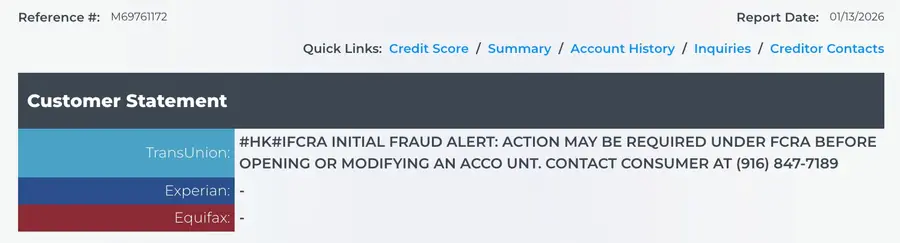
Customer Statement & Fraud Alerts section
What do you see in the example above? The client has an Initial Fraud Alert at TransUnion. This is a special warning that forces the bank to CALL the person back before approving any new credit. Experian and Equifax are empty (a dash), which means the alert is only at one bureau.
When it's useful:
You've been robbed or your SSN was stolen — you set a Fraud Alert and the fraudster can't open credit without a call to you
You appeared in a breach (Equifax 2017, T-Mobile, AT&T, etc.) — preventive protection
Lost your documents or had your wallet stolen
When it's a PROBLEM:
Someone placed a Fraud Alert on your report without your knowledge (often happens after bank fraud)
You set it yourself a few years ago and forgot — now banks call the old number and can't reach you → denial
The alert is only at one bureau (as in the example) — a bank that pulls that bureau will slow down or deny the credit
What to look for in this section
Any text you didn't add yourself. If there's something written in Customer Statement, remember whether you did it. If not, it's either a bureau error or someone else's hands in your report. It's also important to check the phone number in the alert — if it's old or not yours at all, the bank won't be able to reach you when trying to approve credit, and you'll get unexplained denials. Many people spend months not understanding why they're being denied — and the reason is right here.
Inside info from Excalibur Credit Solutions
This section may contain several types of entries, and each affects your credit differently:
Initial Fraud Alert — valid for 1 year. The bank must call you back before opening new credit.
Extended Fraud Alert — valid for 7 years, placed only for victims of actual identity theft.
Active Duty Alert — for military personnel on deployment.
Credit Freeze — completely blocks the report. No bank can pull it. This is the strictest form of protection.
Consumer Statement — your personal statement attached to the report (e.g. "I dispute account XYZ"); all banks see it.
Each such entry affects credit approval. If you have a Freeze, no application will go through — the bank will see "no record". If you have a Fraud Alert, the application will take a long time or involve additional checks. Many don't even suspect they have something set — alerts can remain from past years, be placed automatically after data breaches, or appear by mistake.
3.2 Personal Information
This is your personal data — name, date of birth, current and previous addresses, employers. The most underrated section. 70% of people don't even look at it, and that's a mistake — this is where errors and traces of identity theft most often hide.
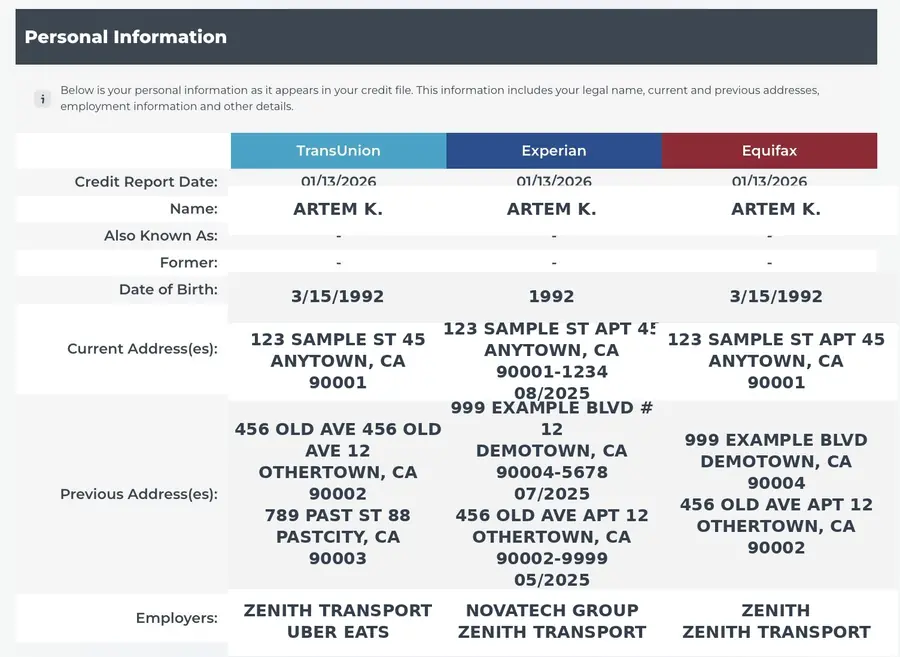
Personal Information section: three bureaus side by side
What to pay attention to
1. Name and Also Known As. If one of the bureaus has your name misspelled, or there's someone else's "Also Known As", that's a serious red flag. Banks check the name and may deny or require additional documents. Someone else's name in Also Known As may be a trace of identity theft or a mix-up with a namesake — such entries need to be removed.
2. Addresses where you never lived. An address you can't explain is the most dangerous find in this section. It may be a leftover from identity theft (a fraudster opened credit in your name at their address) or a bureau error. The bank sees a "strange" address → raises a risk flag → denial or a higher rate.
3. Duplicate entries. The same employer or address recorded twice (like "ZENITH" and "ZENITH TRANSPORT" at Equifax above) — it's not critical for the score, but it clutters the report. It's worth cleaning up so the profile looks tidy.
4. Employers like Uber, DoorDash, Lyft, Instacart. This is a huge pitfall for immigrants. Many do gig-economy side work and don't realize these employers stay in the report. When you apply for an auto lease, the bank sees "Uber Eats" among your employers and thinks: "this person will use the car for delivery/rideshare". Lease programs prohibit this, so you either get denied or offered a commercial program at a much higher rate. The same goes for a mortgage — banks consider 1099 income through apps unstable.
Most people don't know what's in their Personal Information. Yet this is exactly the section where a bank starts its check — and what's written there shapes the first impression of you as a client.
3.3 Credit Score
The most "stressful" section of the report — here you see your three scores from the three bureaus. It's the first thing a bank looks at when evaluating your application.
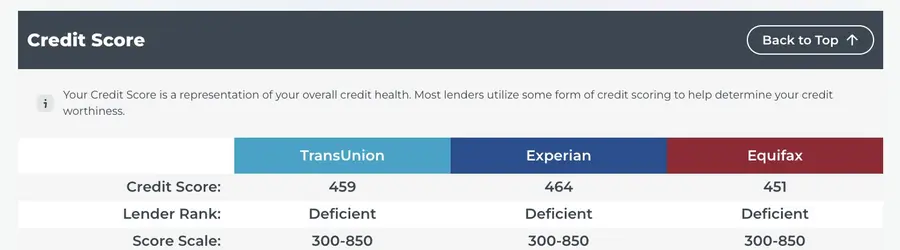
Credit Score section
In the example above the client has three low scores — TransUnion 459, Experian 464, Equifax 451. All three are marked "Deficient", which means that for most banks and credit cards the person practically doesn't exist. Applying for any credit will almost always end in a denial, or an offer of a program at an insane interest rate.
580–669 Fair — approved with a high rate and a low limit
670–739 Good — standard terms
740–799 Very Good — the best terms
800–850 Exceptional — premium products, the lowest rates
What to pay attention to
1. The difference between bureaus. In the example above the gap between Experian (464) and Equifax (451) is only 13 points, which is normal. But if the gap between bureaus is 50+ points, there's a negative sitting in one bureau that the others don't have. For example, a late payment landed only in TransUnion, or a collection only in Equifax. That's the first lead for the work — you need to dig in and find what's wrong.
2. "Deficient" / "Poor" status. This is the category below 580 — the most painful one. At this score banks physically cannot approve most products: mortgages, auto leases, premium cards — all closed. Only secured cards (cards against a deposit) and subprime loans at 24%+ per year are available.
3. Which score the bank actually looks at. The number in the report is not the final verdict. Each bank uses its own FICO model: FICO Auto Score (250–900) for auto, FICO 2/4/5 for mortgages, FICO 8 or 9 for cards. The same person can have FICO 8 = 680 and FICO Auto Score = 720. So the score in IdentityIQ is a reference point, and the bank will see the real picture for a specific type of credit itself.
Inside info from Excalibur Credit Solutions
The score is a consequence, not a cause. Seeing a low score and trying to "raise the score" directly is working backwards. The score rises automatically when the report is cleaned up: late payments, collections and unnecessary inquiries are removed, utilization is evened out. So the main focus should not be on the number but on what shapes it — the sections below (Accounts, Inquiries, Collections).
3.4 Risk Factors
This section shows why your score is exactly what it is and not higher. The bureau analyzes your report and lists the factors pulling the score down. Essentially it's a ready-made roadmap of what to fix first.
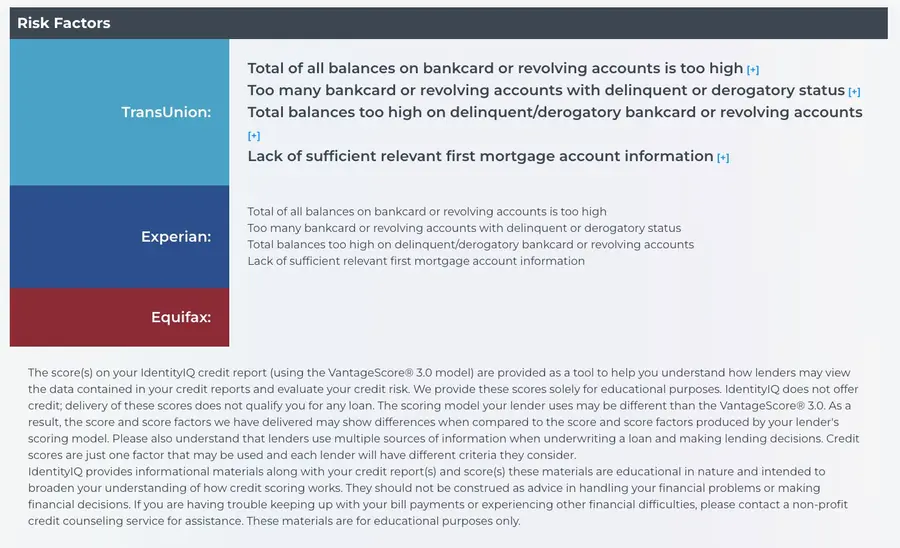
Risk Factors section
In the example above, the client's TransUnion and Experian show the same problems:
"Total of all balances on bankcard or revolving accounts is too high" — total credit card debt is too high
"Too many bankcard or revolving accounts with delinquent or derogatory status" — too many cards with late payments or a negative status
"Total balances too high on delinquent/derogatory bankcard or revolving accounts" — large balances specifically on problem cards
"Lack of sufficient relevant first mortgage account information" — no mortgage in the report (banks like a mix of credit types)
What to pay attention to
1. Each Risk Factor is a specific problem with the score. The bureau doesn't write this for nothing — it states directly what is stopping the score from growing. If the first line says "balances too high", your utilization is above 30% and needs to come down. If it says "delinquent or derogatory status", there are accounts with late payments or charge-offs that need cleaning up.
2. Compare the factors between bureaus. If TransUnion has 4 factors and Equifax only 1, there's more negative info sitting at TransUnion. This often happens when a creditor reports to only one bureau.
3. "Lack of sufficient first mortgage account information" — that's normal if you have no mortgage. It's not a critical factor, but the score won't reach 800+ without a mortgage or auto loan in your history.
4. If you have a VantageScore (not FICO). In the screenshot below IdentityIQ warns that it shows VantageScore 3.0. This is an educational model — banks more often use FICO. The score and factors in FICO may differ.
Inside info from Excalibur Credit Solutions
Risk Factors is the most valuable part of the report for building a strategy. Many spend months trying to "raise the score" without understanding what exactly is pulling it down. And the answer is always here — the bureau itself writes you the diagnosis. An experienced specialist builds an action plan from this list in 5 minutes: what to clean up, in what order, what effect to expect.
3.5 Summary
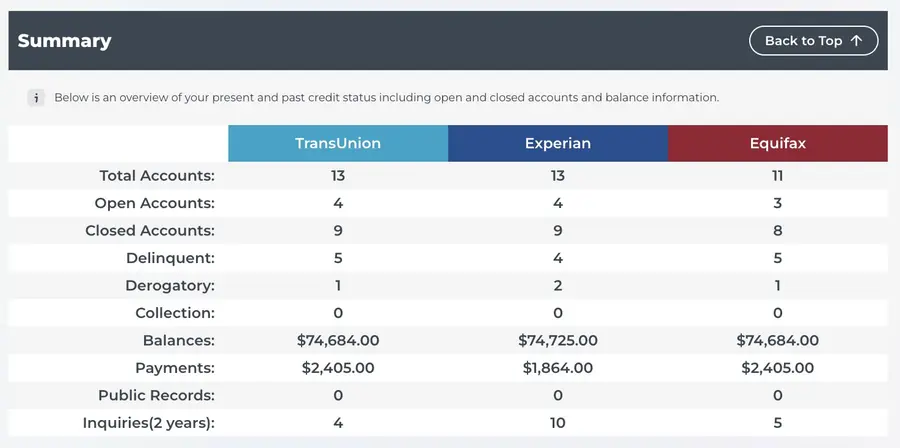
Here are the overall statistics of your report in numbers. At a glance you see the scale: how many accounts you have, how much debt, how many late payments, how many inquiries in the last 2 years.
Summary section
In the example above the client has:
13 accounts at TransUnion and Experian, but only 11 at Equifax — a 2-account discrepancy
4 open, 9 closed — most are no longer active
5 Delinquent + 1 Derogatory at TransUnion — that's a lot of negative info
$74,684 total balance — serious debt
10 Inquiries at Experian vs 4 at TransUnion — banks were actively checking Experian in particular
What to pay attention to
1. A mismatch in the number of accounts between bureaus. In the example above TransUnion and Experian see 13 accounts, while Equifax sees only 11. That means 2 creditors don't report to Equifax. Not critical, but interesting — for example, if you have positive accounts missing from one bureau, your score there will be lower.
2. Delinquent vs Derogatory. Delinquent is a late payment that can still be fixed. Derogatory is already a serious negative (charge-off, collection, bankruptcy). In the example, 5 delinquent + 1 derogatory means 1 account is already "gone" — the bank wrote off the debt.
3. The ratio of Inquiries between bureaus. 10 inquiries at Experian vs 4 at TransUnion means the person applied to banks that mostly checked Experian. Each inquiry lowers the score by 2–5 points and lives in the report for 2 years.
Inside info from Excalibur Credit Solutions
Summary is your report in one picture. When I look at someone's report for the first time, I start with this page. From the numbers I already understand the strategy: many inquiries → a 6-month pause. A high balance → a plan to lower utilization. Several delinquent → payment discipline. Only then do I go into the details.
3.6 Account History (Tradelines)
The biggest section of the report. Here is every one of your accounts — open, closed, charge-offs, auto loans, mortgage, credit cards — with all the details: limit, balance, month-by-month payment history for 2 years.
Let's go through 5 typical scenarios you'll see in your report:
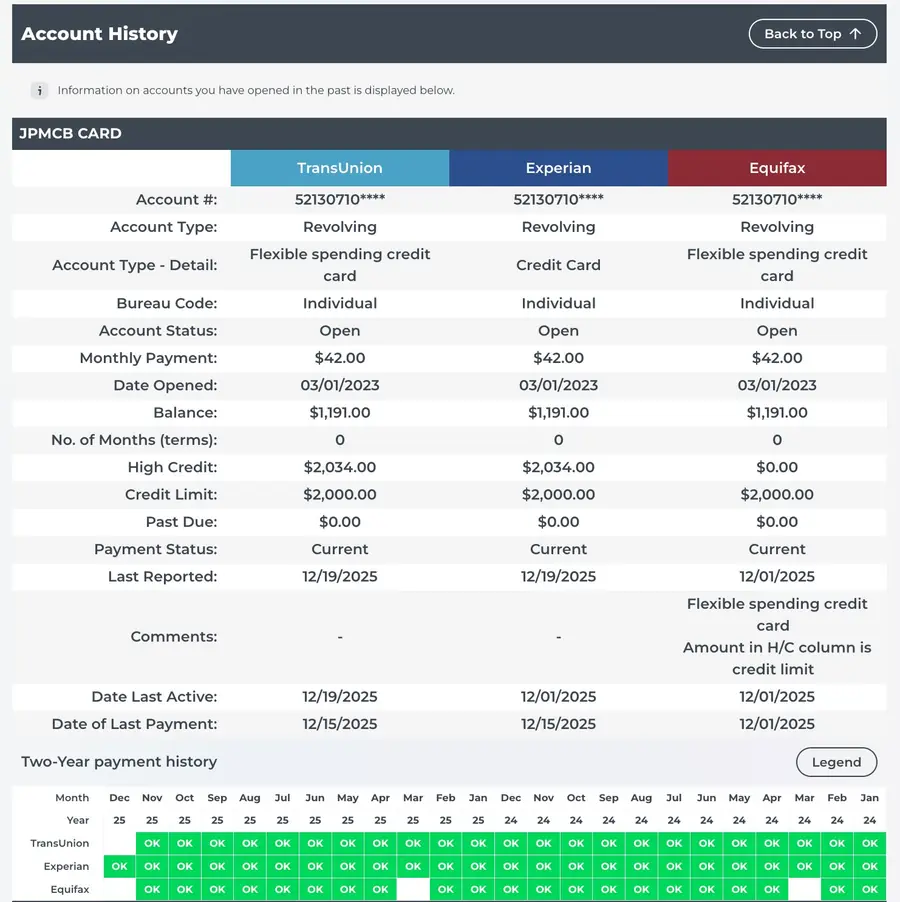
Example 1: A good account (Current)
Example 1: a good account (JPMCB Card)
JPMCB Card — an open revolving card with a $1,191 balance on a $2,000 limit. Payment Status: Current, the payment history is solid green "OK". This is a model account. BUT: utilization here is 60% ($1191/$2000) — that's a lot; ideally keep it below 30%.
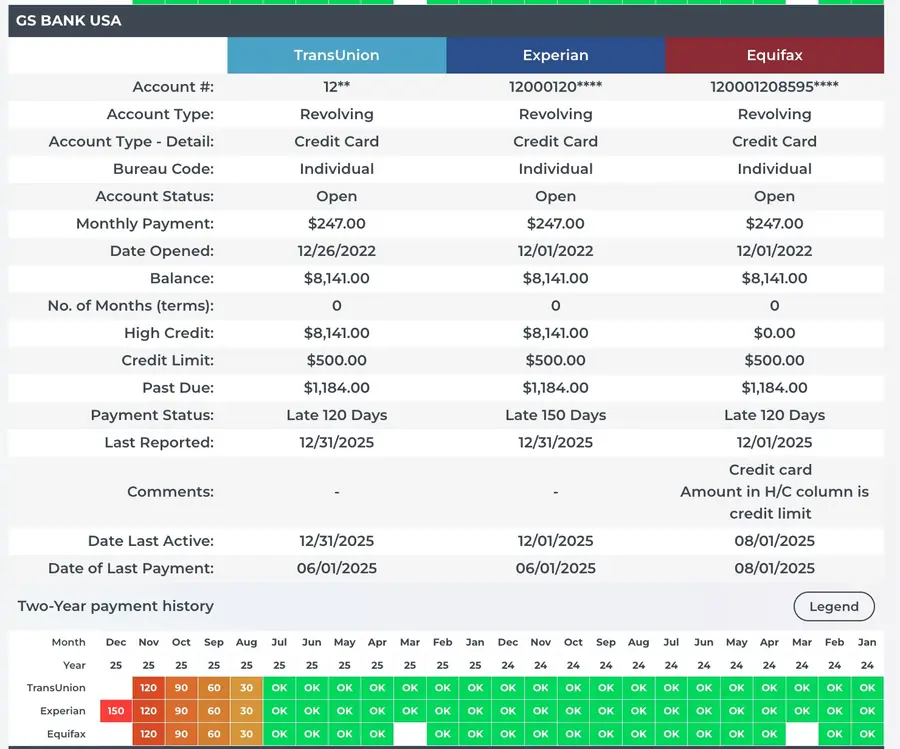
Example 2: A bad account (Late 120 Days)
Example 2: 120-day late payments (GS Bank USA)
GS Bank USA — a card with a limit of only $500, but a balance already at $8,141 (16 times over — that's penalties and interest). Late 120/150 Days. Payment history: OK since August, then 30 → 60 → 90 → 120 → 150 (Experian). This is the classic "stopped paying six months ago" picture. Minus 100+ points.
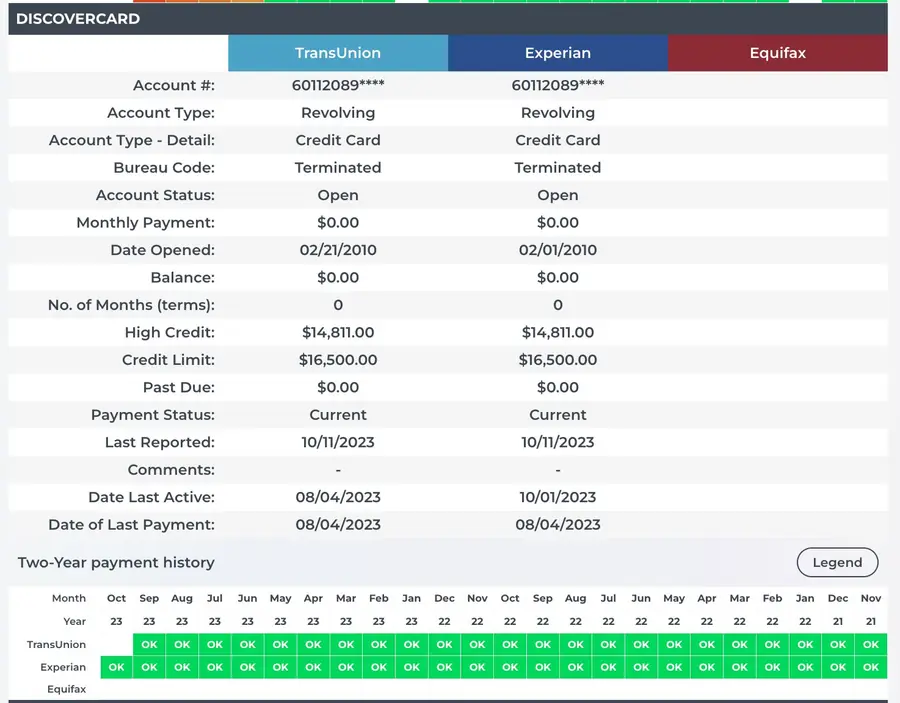
Example 3: A tradeline service (junk that needs to be removed)
Example 3: an old Discover account
At first glance it's a great card: opened in 2010, a $16,500 limit, a perfect payment history. But look closely: Bureau Code: Terminated, plus this entry exists only in TransUnion and Experian and is missing from Equifax entirely. This is not really your card — it's a tradeline service like Credit Boost, Boost Credit, Self or Kikoff. Such services add you as an authorized user to an old card with a good history. When payments for the service stop, the entry is marked Terminated and stays in your report as clutter. Many think "whatever, the limit is big and the history is long — let it be". That's a mistake. Banks see a terminated entry, and it no longer helps your profile. Such entries are better disputed so the report looks clean and current.
Example 4: Auto Lease (Installment) (Installment)
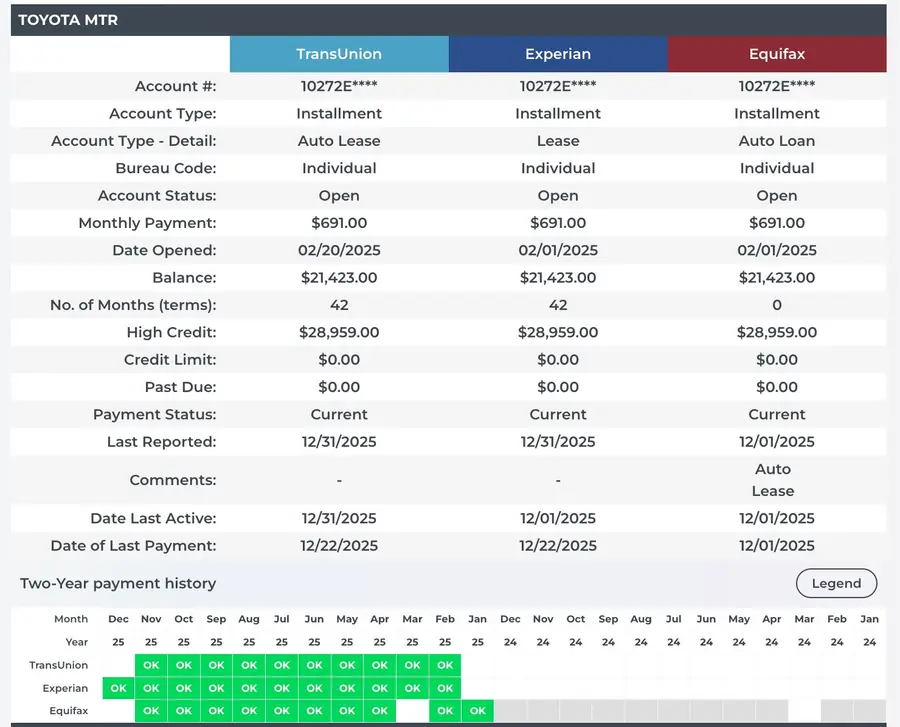
Example 4: a Toyota Motor auto lease
Toyota Motor — an auto lease opened in February 2025, $21,423 balance over 42 months, $691 monthly payment. Account Type: Installment (as opposed to Revolving for cards). Current, all payments OK. Installment accounts help build your credit mix — banks like to see different types of credit (cards + auto + mortgage).
Example 5: Charge-off / Collection / Collection (the harshest)
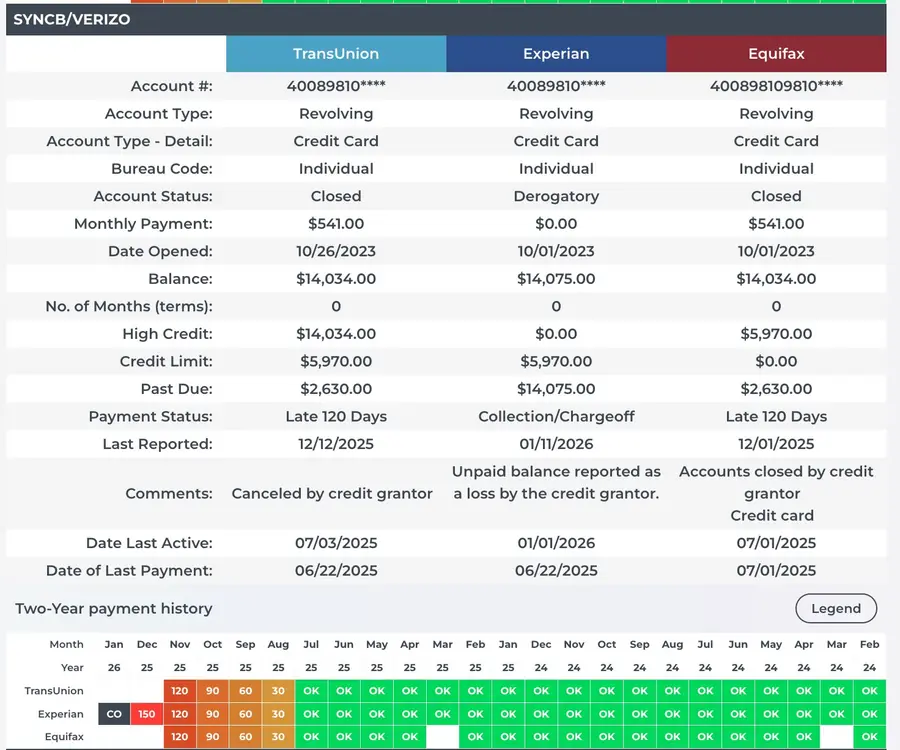
Example 5: a SYNCB / Verizon charge-off
SYNCB/Verizon — a Synchrony Bank/Verizon card opened in October 2023. Balance $14,034 against a $5,970 limit. Status: Closed/Derogatory, Collection/Chargeoff. History: everything was OK, then sharply 30 → 60 → 90 → 120 → CO (Charge-off). Comment: "Unpaid balance reported as a loss by the credit grantor". This means the bank wrote the debt off as a loss. Minus 100–150 points and a mark in the report for 7 years.
What to pay attention to
1. Payment Status is the main field. Current = all good. Late 30/60/90/120/150 — escalating delinquency; the more days, the bigger the hit to the score. Charge-off / Collection — the bank wrote off the debt.
2. Two-Year payment history (the squares). Green OK = good. Yellow/orange/red numbers = late payments. Black CO = charge-off. Gray squares = the bureau didn't receive data for that month (that's not bad).
3. Discrepancies between bureaus. Often the same account looks different at the three bureaus — for example, GS Bank USA shows Late 120 at TU/EQ but Late 150 at Experian. That means Experian received more recent data.
4. Tradeline services and authorized users. If your report has an account like example 3 (old, perfect, marked Terminated, only in one or two bureaus), it's most likely a trace of a tradeline service that was no longer paid for. Such terminated entries need to be cleaned up, while an active authorized user line, on the contrary, works for your profile. Your genuinely old cards (the ones you opened and used yourself) — don't close them, they hold up your Average Age of Accounts.
5. Utilization (use of the limit). Calculated as: balance / credit limit × 100%. Ideally keep it below 10%, up to 30% is fine. JPMCB is above 60% — that already lowers the score.
Inside info from Excalibur Credit Solutions
Account History is the heart of the report. 65% of your score lives here (35% Payment History + 30% Amounts Owed). One charge-off like the SYNCB/Verizon one can kill your score by 100+ points and shut the door to most banks. On the other hand, one real, old, clean card (your own, not a tradeline service) can keep you in the Good category even when the rest is so-so. Every account here is either an asset or a liability for your credit history.
3.7 Inquiries
Every time you apply for credit, the bank makes a hard inquiry — a request to the bureau. These inquiries stay in the report for 2 years and lower the score by 2–5 points each.
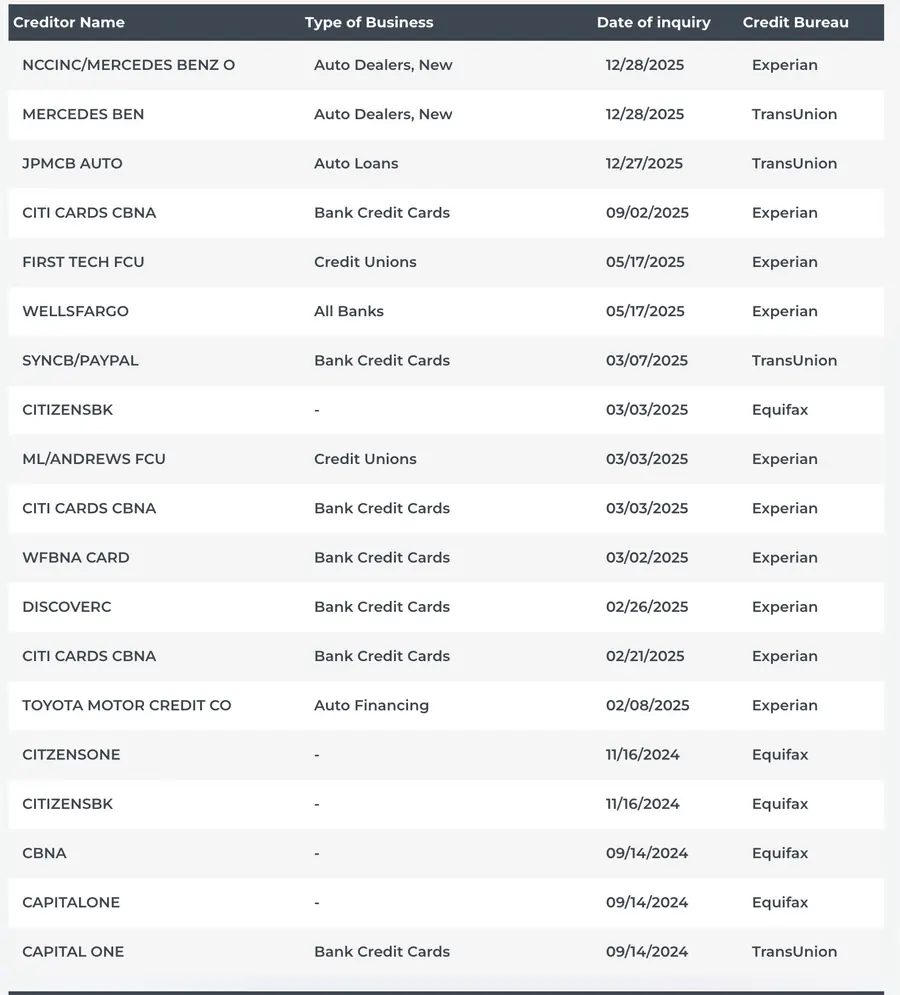
Inquiries section
The example above shows the classic picture of a report overloaded with inquiries:
December 2025: NCCINC/MERCEDES BENZ + MERCEDES BEN + JPMCB AUTO — three inquiries in a row; the person was clearly applying to buy a Mercedes
February–March 2025: CITI CARDS (3 times!) + DISCOVER + WFBNA + SYNCB/PAYPAL — a series of card applications
May 2025: FIRST TECH FCU + WELLSFARGO on the same day — applied to a credit union and a bank at the same time
What to pay attention to
1. Clustered inquiries. If you have 5+ hard inquiries in 6 months, it's a red flag for banks. They think: "this person is urgently looking for money, something is wrong". And they deny, even if the score is fine. In the example above the client has a whole series of inquiries in a row — a signal of financial trouble.
2. Duplicate inquiries. See "CITI CARDS CBNA" three times — 09/02, 03/03 and 02/21? That means the person applied to Citi 3 times (or once, and Citi checked them several times). Each check = -2 to 5 points.
3. Auto Inquiries are a special case. When you apply at a dealership, the dealer often "shops" your credit to 5–10 banks at once — each one does a hard inquiry. Under the FICO rule all auto inquiries within 14–45 days count as one. But many immigrants don't know this and agree to ten checks in a row.
4. Inquiries at only one bureau. In the example: 12 inquiries at Experian, 4 at TransUnion, 5 at Equifax. That means banks check Experian more often — and that's exactly where this client's lowest score will take longer to recover.
5. Hard vs Soft. This section only has hard inquiries — the ones you initiated yourself by applying. Soft inquiries (pre-approved offers, your own score checks) do NOT affect the score and usually aren't shown in this section.
Inside info from Excalibur Credit Solutions
The most common immigrant mistake: "I didn't get the card, I'll try one more bank. Still didn't get it — I'll try a third one". By the fifth denial the score is already down 25 points from inquiries, plus banks see a string of denials and stop — they deny automatically. Don't apply "for luck". First check your report, understand what's wrong with it, fix it — then apply to one carefully chosen bank that fits your profile.
GOOD TO KNOW · All of this can be disputed
Now that you've figured out the sections and seen real examples, the main question is — can anything be done about it? The short answer: yes, and most of the negative can be removed entirely.
What can be disputed in a report
Late payments (30/60/90/120 days) — even if they really happened
Charge-offs — debts written off by the bank
Collections — debts sold to collectors
Hard inquiries after which you did NOT open an account — the bank checked you, denied you, and the hit to the score stayed for 2 years
Tradeline services with Terminated status (Credit Boost, Self, Kikoff and similar)
Duplicate accounts — when the same debt is recorded twice
Inaccurate addresses, names, employers in Personal Information
Public Records — court judgments, tax liens
Old fraud alerts you forgot about that get in the way of approvals
Bankruptcy — in some cases
This works under the federal FCRA (Fair Credit Reporting Act) — it requires the bureaus to remove any information the creditor cannot fully confirm with documents. In practice the bureaus remove 30–60% of disputed negatives simply because creditors often don't have a complete set of documents or don't respond in time.
It's just important to understand
It's not magic and it doesn't disappear on its own. Each account is disputed separately — you need to state the reason correctly, send letters to all three bureaus, wait for the response, and if refused, file a repeat dispute on a different basis, use the FDCPA against collectors, debt validation against the original creditor, and so on. One person can spend 6–12 months on this and get no result. A professional does the same in 2–4 months, because they know exactly which wording works, which bureaucratic loopholes to use, and in what order to approach each bureau.
Inside info from Excalibur Credit Solutions
The most underrated item: hard inquiries with no account opened. You applied for a card → got denied → minus points for 2 years. Most people don't even suspect these inquiries can be removed. Under the FCRA, if you did not give written permission for that specific check, or if the check did not result in an account being opened, the inquiry can be disputed as "unverified". Each removed inquiry = +2–5 points. For a client with 12 inquiries this easily gives +30–50 points just from cleaning up this section.
REAL CASE · What it was vs what it became
Remember the screenshots from Part 3, where we went through a report with a $14,034 charge-off (SYNCB/Verizon), Late 120/150 Days (GS Bank), a pile of delinquent accounts and $74,684 in total debt? That's a real Excalibur Credit Solutions client. Here's what happened: 3 months to clean up and prepare the profile + 2 weeks to approval and delivery of the car:
Starting score
459 / 464 / 451
Deficient at all 3 bureaus
After 3.5 months
700+
Good category
What was done
All negatives removed from the report (charge-off, late payments, collections)
Extra hard inquiries cleared
A credit boost was done — quality tradelines added
Financed: a 2022 Mercedes-Benz GLE 63 S AMG
2 new credit cards opened with limits of $35,000 and $5,000
Mercedes-Benz GLE 63 S AMG (2022) — financing
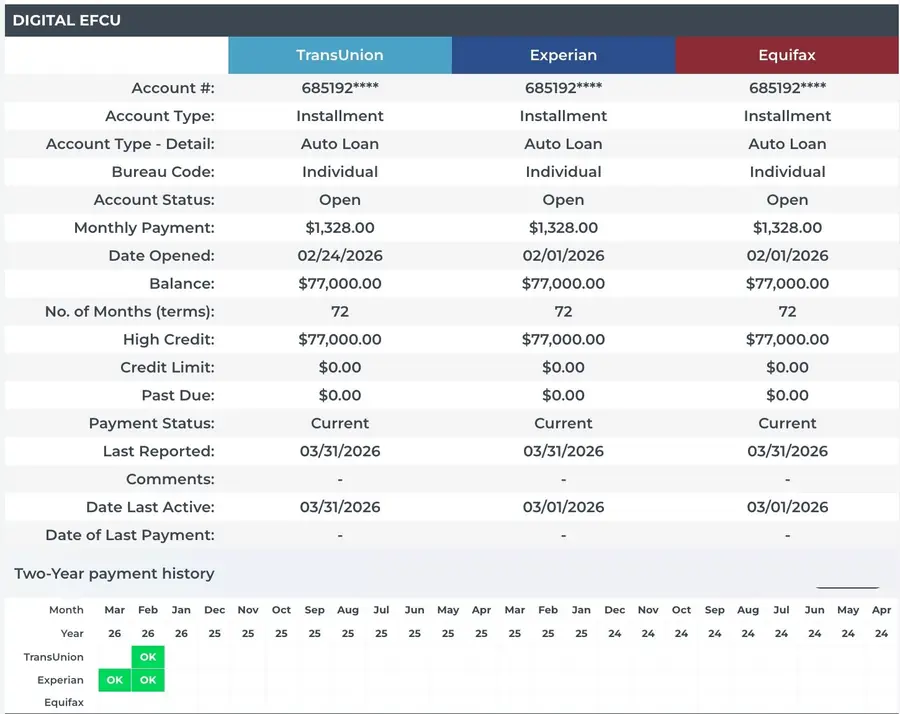
An auto loan for $77,000 over 72 months, monthly payment $1,328, status Current. After 3 months of work on the report the client applied to the bank, and in ~2 weeks got approved and drove out of the dealership in the car.
Client case: a Mercedes-Benz GLE 63 S AMG auto loan in the report
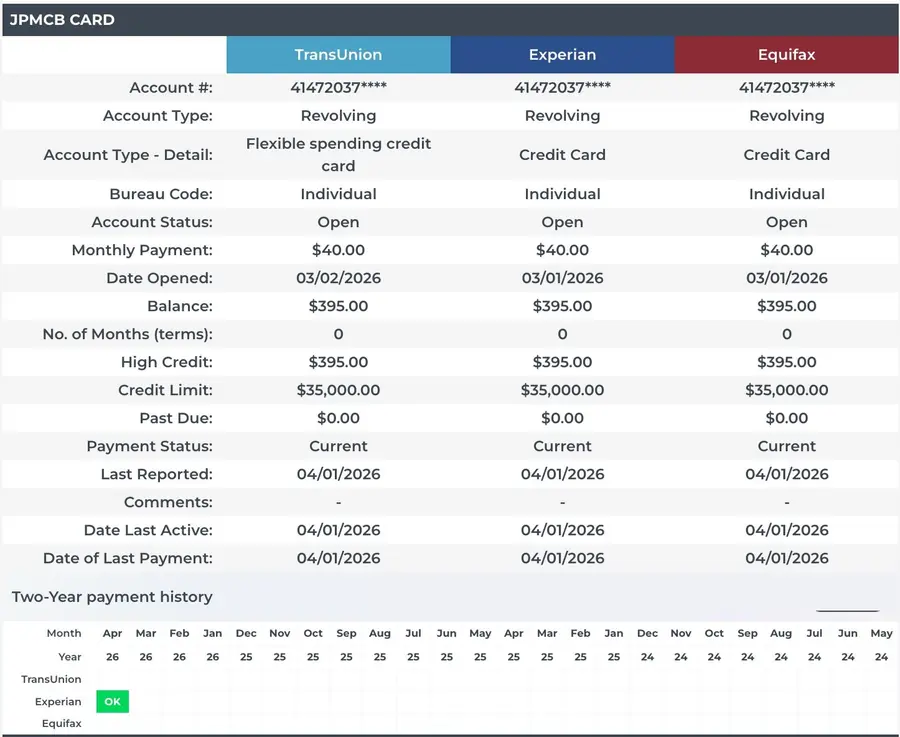
JPMCB Card — $35,000 limit
A premium Chase credit card with a $35,000 limit. That's the level of people with a 740+ score. Approved in parallel with the auto loan — banks saw a clean report and started issuing credit on their own.
Client case: a JPMCB card with a $35,000 limit
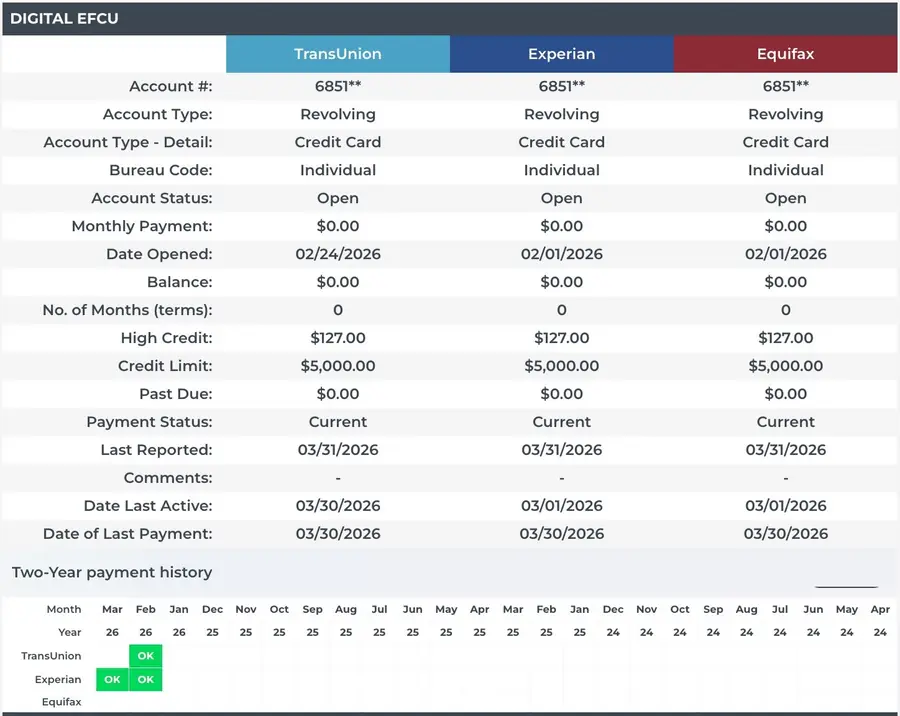
Digital EFCU — $5,000 limit
An additional credit card from Digital Federal Credit Union with a $5,000 limit for credit mix and lowering overall utilization.
Client case: a Digital FCU card
What this means for you
This client came to Excalibur Credit Solutions with the same problems you may be seeing in your report right now — charge-offs, late payments, bank denials. In 3.5 months (3 months to clean the profile + 2 weeks to approval) his life changed: the negatives were removed, the score was rebuilt, and instead of denials — a 2022 Mercedes GLE 63 S AMG and cards with serious limits.
It's not magic and not marketing. It's systematic work: disputing negatives under the FCRA, removing inquiries, a well-planned credit boost, and targeted applications to the right banks at the right moment. You can't replicate this on your own — you need experience, an understanding of the system and access to the right tools.
PART 04 · Review checklist
Once you've ordered your 3B report, go down this list and tick off each item:
What to check in the report
Compare the three FICO scores — find where the gap is 50+ points
Check Personal Information — are there unfamiliar addresses/employers
Find all hard inquiries — mark those where you didn't apply
Check every account — are they all really yours
Find all late payments — write down dates and amounts
Find all collections — write down the original creditor
Check charge-offs — compare the dates with late payments
Calculate the utilization rate (balance / limit) for your cards
Check Public Records — bankruptcies, court judgments
Check account opening dates — are there any you didn't open
275 cards from 88 banks and 82 credit unions: which give real limits and which eat you up with fees and a $300 ceiling.
15 minutesReference
What makes a card good or junk
A card is valuable for three things: a real revolving limit (not your own money), a high ceiling, reasonable fees and APR. If a card fails these, it's useless, even if it's "easy to get approved".
Good
Real credit, high limits ($10k+), a normal APR. A good score is needed.
Average
A real card with a modest ceiling or a legitimate "stepping stone", including secured cards from major banks that convert to regular ones.
Bad
Low limit, high fees or a "builder gimmick" without a real limit. Useless for growth.
What to avoid
Chime / Current / Varo are not credit cards but builder tools (the limit = your own money). Mission Lane, Credit One, Merrick: tiny limits ($300–$1,500) and high fees. First Premier, Total, Surge, Indigo, Milestone, Fortiva: APR up to 36% and fees "for air". In the tables below they are all marked as bad.
Chime Credit BuilderNo interest and no fees; a Chime account is needed. ❗ Not a real credit card: the limit = your own money in the account, the limit isn't reported.
37. Bangor Savings Bank (EverBlue)See if you're pre-approved; a regional bank (New England). MID-TIER $500 – $15,000 Check →Check →
38. TD BankCheck your personal pre-approved offers from TD. MID-TIER $300 – $20,000 Check → SUBPRIME For rebuilding — a real chance of approval.Check →
39. Credit One BankSee if You Pre-Qualify; for credit rebuilding. SUBPRIME $300 – $1,500 Check →Check →
44. Aspire (Cash Back Mastercard)No deposit, limit up to $1,000, up to 3% cashback; rebuilding. SUBPRIME $500 – $1,000 Check → S E C T I O N 2 Personal loans 26 PRIME Top issuers, high limits — a good score is needed.Check →
Section 2 · Personal loans · 26
1. SoFiView Your Rate / soft-pull prequalification. PRIME $5,000 – $100,000 Check →Check →
2. Discover Personal LoansCheck Your Rate. PRIME $2,500 – $40,000 Check →Check →
3. PenFed Credit UnionOn the page choose Check My Rate / Pre-qualify. PRIME $600 – $50,000 Check →Check →
4. First Tech Federal Credit UnionA preliminary check, then a full application. PRIME $500 – $50,000 Check →Check →
5. Citizens BankCheck rate with no impact on your score. PRIME $5,000 – $50,000 Check →Check →
6. TruistPrequalify for personal loans. PRIME $3,500 – $50,000 Check →Check →
7. PNC BankCheck rate; for clients and new applicants. PRIME $1,000 – $35,000 Check →Check →
8. Navy Federal Credit UnionNFCU membership required. PRIME $250 – $50,000 Check →Check →
What Chase, Amex, Bank of America, Wells Fargo and Citi like, how to fill out applications correctly and increase your chance of a high limit.
6 minutesStrategy
Most people fill out applications incorrectly. The bank looks not only at the score: at income, utilization, inquiries, account history and even at how the application is filled out.
01Chase
They like a clean credit history and a small number of new inquiries.
Better to apply when utilization is below 10–15%.
If you already have a Chase checking account, the chance is higher.
State your real total income, including business income if you have it.
Don't understate your income: banks often set the limit based on the stated income.
If you rent, enter a real and stable monthly housing payment.
Don't make 5–6 applications in a row before Chase: they look very closely at recent accounts.
02American Express
They like clients who actively use the card and pay on time.
Even if the starting limit is average, they often give an increase later.
In the application, stable income and a normal payment history matter.
They don't like missed payments even by a couple of days.
If your first Amex card was handled well, the next ones are much easier to get.
03Bank of America
They really like relationship banking.
If you keep money with them in checking/savings, trust is higher.
Income should look logical relative to your debts.
They don't like credit cards that are too heavily used.
They sometimes give very good limits to clients with normal cash flow.
04Wells Fargo
They look at the debt-to-income ratio and the number of new accounts.
It's better to apply when there aren't many recent inquiries.
Job position and income should look stable.
They don't like it when a person has opened many cards in a short time.
05Citi
They look very closely at inquiries and new accounts.
If utilization is low, the chance of a good limit is higher.
For income, state your full real income.
Better not to apply right after other banks.
They often give good limits to people with a strong FICO and a long history.
What to write in applications
Income. Full real income that you can explain.
Housing payment. Don't write random numbers: the bank looks at the ratio of income to rent.
Job title. A normal, stable job title, not vague wording.
No errors in the address, phone and employment information.
Business income can also be counted, if it's real.
Lower your utilization before applying.
Mistakes that get your limits cut
10+ inquiries in a short time
High utilization
Late payments
Too many new cards
Incorrect income
Applying to several banks at once
The main idea
Even with the same score one person gets a $2,000 limit and another $20,000. The difference is often precisely in the application strategy.
Where an immigrant can realistically open an account with minimal risk of a freeze, 5 reasons for freezes and the two-bank rule.
7 minutesFor immigrants
Opening an account is half the job. The main thing is that it doesn't get closed. Banks increasingly freeze accounts automatically: an incoming transfer from abroad, a large cash deposit or unusual activity, and access to your money is cut off without explanation. Below are 5 banks where it's easier for an immigrant to open an account with a lower risk of a freeze, plus what to do to avoid one.
1Chase Total Checking
A huge network in California and many years of experience with international clients.
Best of all: everyday account and cash.
Opening: at a branch.
Plus: used to immigrants, ATMs everywhere.
2Citibank Checking
The strongest for international transfers: they accept incoming wires from abroad more calmly.
Best of all: transfers abroad.
Opening: at a branch.
Plus: a global network, convenient if relatives are abroad.
3Capital One 360 Checking
Fully online, no fees and no minimum balance. Fewer "manual" freezes.
Best of all: an online "second account".
Opening: online, no deposit to open.
Plus: $0 fees and no minimum balance.
4Amex Rewards Checking
A premium bank's online account: 1% on the balance and Membership Rewards points. Available to those who've had an Amex card for at least 3 months.
Best of all: if you already have an Amex card.
Opening: online.
Plus: points on purchases and 1% on the balance.
5Wells Fargo Everyday Checking
A large network, multilingual support and loyalty to newcomers.
Best of all: if there is a branch nearby.
Opening: at a branch, $25 to open.
Plus: branches in almost every neighborhood.
Caution: Bank of America
It's the easiest to open, which is why it's recommended first. But it was BofA that in 2025–2026 froze immigrants' accounts more often than others, nitpicking about immigration status. You can open one, but don't keep all your money there — only as one of two accounts.
5 reasons accounts get frozen
A large or unexplained wire. Especially incoming from abroad without a clear source of funds.
A large cash deposit. An amount that stands out from the account's usual history.
Transfers abroad without a pattern. The system sees irregular transfers as an anomaly.
Going negative. A long negative balance is a frequent reason for closure.
A simple account. No activity for a long time; the bank considers the account "dormant".
The system catches a pattern, not an intent. Even honest money looks suspicious if it breaks from the usual picture on the account.
How to avoid getting frozen
Warn the bank in advance about a large transfer or deposit.
Keep proof of the source of funds: a contract, an invoice, a bill of sale.
Keep steady, predictable activity on the account.
Separate personal and business finances.
The two-bank rule
Keep accounts at a minimum of two different banks. If one gets frozen, you're not left without money: rent, salary and emergency expenses keep going from the second. This is the foundation of financial security for an immigrant in the US.
Five Amex cards, a points strategy, the welcome bonus and Amex Offers: how to save thousands of dollars in the US.
6 minutesPractice
How to use Amex cards, earn points and cashback and save thousands of dollars in the US. Five cards, a points strategy and Amex Offers.
Amex Gold · restaurants and groceries
The main plus: a lot of points for ordinary everyday purchases.
Who it suits
Often eats at restaurants
Buys groceries
Orders Uber Eats / DoorDash
Loves to travel
How to use it correctly
Pay for groceries and restaurants with this card
Don't spend points on small purchases
Save points for flights and travel
Keep an eye on the Amex Offers section
Amex Platinum · premium for travel
Important: part of the annual fee is recouped through bonuses.
What it gives
Access to airport business lounges
Hotel bonuses and discounts
Uber credits and travel benefits
VIP privileges
How to use it correctly
Buy flights with this card
Use the airport lounges
Activate all bonuses in the app
Use the hotel and travel credits
Blue Cash Everyday · simple cashback
The main plus: simple cashback with no complications, a good start for credit history.
Who it suits
Gas and fill-ups
Supermarkets and groceries
Online purchases
How to use it correctly
Use it for everyday purchases
Always pay on time
Don't keep a big debt on the card
Blue Cash Preferred · more cashback
The main plus: families get back hundreds of dollars of cashback a year.
Who it suits
Spends a lot on groceries
Often fills up the car
Pays for subscriptions
How to use it correctly
Use it for groceries and gas
Enroll in Amex Offers
Try to pay off the balance in full
Amex Business · for business and the self-employed
The main plus: big limits and a huge number of business points.
Who it suits
Own business or LLC
Self-employment
Running ads
Business expenses
How to use it correctly
Pay for advertising and subscriptions
Run business purchases through it
Pay for travel with this card
Separate personal and business expenses
Strategy: how to earn the most points
Welcome bonus
60,000 – 150,000+ points. People get the most points precisely for the welcome bonus, for spending a certain amount in the first months.
Amex Offers
The American Express app has an Offers section: discounts and cashback, bonus points, free credits. Many people don't use Offers at all and lose money.
A card is a tool. Points are money.
Use Amex wisely: watch the Offers, save points for travel and collect the welcome bonus. And the card will start working for you.
Through Credit Karma, through the Robinhood app and by a friend's invitation: requirements, a step-by-step application, soft and hard pull and what to do after approval.
7 minutesStep by step
3%
cashback on all purchases
$0
annual fee for the card itself
$50 a year
Robinhood Gold subscription ($5 a month)
The Robinhood Gold Card is a Visa Signature credit card from the broker Robinhood. Its main feature is 3% cashback on all categories with no caps and no rotation, and 5% on travel booked through the Robinhood portal. The card is available only to Robinhood Gold subscribers, so the real cost of ownership is the subscription price. Card terms change; check the current ones in the app before applying.
What you need before applying
A Robinhood account with completed identity verification: name, SSN, date of birth, US address.
An active Robinhood Gold subscription. The card isn't issued without it; you can cancel the subscription later, but the card will be closed.
Age 18+, stable income you can confirm, and a clean last 12 months with no late payments.
A score benchmark: approvals most often start from FICO 700+ with low utilization and no recent hard inquiries.
Matching personal details across the three bureaus: an unfamiliar address or an error in your name is a common reason for denial.
Three ways to open the card
First check the offer in Credit Karma: if it's there, that's the fastest path. If there is no offer, take the official path through the Robinhood app or an invitation from an existing cardholder.
Path 1 · Through Credit Karma
Open Credit Karma and go to the Credit Cards section (or For You).
Find the Robinhood Gold Card offer. If it isn't in the list, this path isn't available to you right now — move on to path 2.
Check the Approval Odds. This is Credit Karma's forecast, not the bank's promise: Good and Very Good mean good chances, Fair means it's better to get your report in order first.
Tap Continue / Apply. You'll be redirected to Robinhood: sign in or create an account.
Subscribe to Robinhood Gold, if you don't have the subscription yet.
Fill out the application: name, SSN, date of birth, address, income. A soft pull comes first — you'll be shown a preliminary decision and limit.
Accept the Cardholder Agreement. Only after that is the hard pull done and the final decision made.
What to remember
An offer in Credit Karma doesn't guarantee approval. Approval Odds is a forecast, not a promise. If there is no offer, don't look for workarounds — go through the Robinhood app.
Path 2 · Through the Robinhood app
Install the Robinhood app and open an account: ID details, SSN, address, identity verification.
Subscribe to Robinhood Gold in the account menu: $5 a month or $50 a year.
Open the Gold Card section (Menu → Robinhood Gold → Credit Card).
Tap Join Waitlist. The card is issued by invitation: the queue takes from a few days to a few weeks.
Wait for the invitation — a push notification and an e-mail will arrive.
Fill out the application: name, SSN, date of birth, address, annual income, employment. A soft pull will show a preliminary decision and limit.
Accept the Cardholder Agreement — after that the hard pull is done and the final decision arrives. The virtual card appears in the app immediately; the physical card arrives by mail in 7–10 days.
Path 3 · By a friend's invitation
A Gold Card holder sends you an invite from their app (card section → Invite / Refer).
Open the link from the invitation and sign in to Robinhood or create an account.
Subscribe to Gold and fill out the same application. The invitation skips the waitlist but doesn't affect the bank's decision.
Soft pull and hard pull
Soft pull — a preliminary check: doesn't affect your score, visible only to you, shows a preliminary decision and limit.
Hard pull — the official inquiry when you accept the Cardholder Agreement: visible to creditors for two years and may temporarily lower your score by a few points. Robinhood does one hard pull per application.
After approval
Add the virtual card to Apple Pay or Google Pay and use the card until the physical one arrives.
Turn on AutoPay for the Statement Balance: pay in full and don't overpay interest.
Keep utilization low: pay before the statement date so a small balance goes to the bureaus.
Cashback goes to your Robinhood brokerage account: you can withdraw it, invest it or spend it.
Don't cancel the Gold subscription while you use the card: without Gold the card is closed.
If you were denied
Don't reapply right away: every application is a new hard pull. Request the letter with the reasons for the denial, go through your three-bureau report and fix the causes: lower utilization, remove unnecessary inquiries, correct errors in your personal details. A new attempt usually makes sense in 3–6 months. Want a manager to look at your report — send it to us, we'll review it for free.
How much one inquiry costs, why ten inquiries from a dealer are worse than a late payment, which can be disputed under FCRA § 604 and how not to create new ones.
6 minutesBreakdown
What a hard inquiry is
Every time a bank, dealer or lender reviews your application and requests your report from a bureau, a hard inquiry entry appears in the report. Unlike a soft inquiry (checking yourself, pre-approval, monitoring), a hard inquiry is visible to other creditors and affects the score.
How much it costs
One inquiry usually takes off 3–5 FICO points, stops counting toward the score after 12 months and disappears from the report after 24. The problem isn't one inquiry, it's how many there are.
Why they get you denied or given small limits
Five or more inquiries in six months a bank reads as "this person urgently needs money" — for a lender that's a risk.
Car dealers often send one application to 8–12 banks: one visit to the showroom turns into a dozen inquiries.
Banks' scoring models count inquiries separately from FICO: even with a 720 score an application may be denied or approved with a minimal limit.
New inquiries "eat up" the effect of fresh cards: the bank sees that you just opened an account and are asking for money again.
An example from practice
David A. from Glendale had ten dealer inquiries in three months, a score of 530 and two auto loan denials. After disputing the inquiries made without written consent, Equifax removed them, the score rose by 24 points, then came the collection and charge-off, and 140 days later the bank approved an auto loan for a 2025 Mercedes-Benz E63.
Which inquiries can be disputed
Under FCRA § 604 a creditor may request your report only with a "permissible purpose": your application, your written consent, an active account. If there was no consent, the inquiry is disputed: the bureau requests confirmation from the source, and without a document the entry is removed. An inquiry you consented to yourself cannot be disputed, and we do not promise that.
How not to create new ones
Before an auto loan, get pre-approval at one or two banks, not "everywhere the dealer sends it".
Submit auto loan or mortgage applications within one 14-day window: FICO counts them as one inquiry.
Use pre-approval with a soft pull — the list of banks is in the article "Where to get pre-approval".
Check your report once a month through monitoring: an unfamiliar inquiry is the first sign of data theft.
Not sure which inquiries are legitimate? Send us your report — we'll review it for free within 24 hours during business hours.
Average timelines for small, medium and large cases from our experience, the first results and what can be sped up.
5 minutesBreakdown
Why "in a week" doesn't happen
The bureau verifies every disputed entry with the source — the bank, collector or dealer — and waits for its response. We send disputes to all bureaus where the entry appears at once and correspond with each of them. That is why the first changes are visible in weeks, not days, and a full case goes in rounds.
Average timelines in our cases
Small cases — two or three accounts, hard inquiries, data errors: from one to three months.
Medium cases — several entries at several bureaus, collections, charge-offs: from one to six months.
Large cases — many entries, repeat disputes, preparation for financing: up to a year.
These are the company's averaged timelines. The result for a specific entry depends on the bank, the amount owed, the account type and how quickly the sources respond: sometimes everything is resolved faster, sometimes the entry has to be disputed again.
First results
In small cases the first removed entries usually appear after the first round of responses — in two to six weeks. For Alexander M. four entries took 135 days, for David A. together with a credit boost — 140.
What can be done quickly
What works fast is what doesn't require a dispute: lowering card utilization (effect within one reporting cycle), a credit boost via authorized-user lines (also one cycle), correcting the address and spelling of the name. That's why in our cases the "fast" steps go in parallel with disputes.
Want to know the real timeline for your report? Send it to us — we'll review it for free within 24 hours during business hours.
Five blocks of the report where errors hide, and what to check first.
6 minutesFor beginners
Every bureau's report consists of the same blocks, and errors most often live in three of them.
Personal information. Name, addresses, SSN, employers. Someone else's name or address is a sign of a mixed file.
Accounts (tradelines). Each account: opening date, limit, balance, month-by-month payment history. Look at "30/60/90 late" and the "charge-off" status.
Collections. Debts handed over to collectors. Check whether the debt is yours and whether it's counted twice: with the original creditor and with the collector.
Inquiries. Hard inquiries stay for two years. Each one you didn't consent to can be disputed.
Public records. Bankruptcies. Chapter 7 drops off after 10 years, Chapter 13 after 7.
What to check first: dates of late payments (older than 7 years shouldn't be shown), collection amounts, duplicate accounts, unfamiliar addresses and inquiries from the last 24 months.
The three bureaus' reports differ: a creditor may not have reported to all of them. Check all three.
You get your report from a monitoring service in a few minutes: what to look at there and how to save it.
4 minutesFor beginners
The easiest way to get a three-bureau report — Experian, Equifax and TransUnion — is through a monitoring service: SmartCredit, IdentityIQ or MyScoreIQ. Trial access costs about $1, and the report is ready right after registration.
Secured card, pledge loan, credit builder, authorized user: where to start and in what order so you have real cards in a year.
6 minutesFor beginners
Without a history, banks can't see how you pay, so the first products are built on a deposit, on someone else's history or on a small loan you repay to yourself. The goal of the first year is three or four accounts that report to the bureaus every month without a single late payment.
Secured card. You put down a $200–500 deposit, and it becomes your limit. After 6–12 months of careful payments many banks return the deposit and convert the card to a regular one. Choose a card with no annual fee that reports to all three bureaus.
Pledge loan (share secured loan). A loan at a credit union secured by your own deposit: you put, say, $500 into a savings account, the union lends you that $500 for 6–12 months, and you repay it on schedule. The payments are reported as an installment loan, the money stays yours and the union takes no risk, so almost everyone is approved. Navy Federal, PenFed and many local unions offer such loans at 2–4% a year.
Credit builder loan. A similar scheme in reverse: the bank or service holds the loan amount in an account, you make the payments, and at the end of the term you receive the money. You get installment history and small savings.
Authorized user. A close person with a long-standing clean account adds you as a user, and the account's history appears in your report. Important: the account must be old, with low utilization and no late payments. Such a line can also be added through us — that is a credit boost.
A store card or a secured card at your own bank. Store cards and regional banks where you already have a checking account approve more readily. The limit will be small, but the history will start.
Rent and utility payments. Rent reporting services send your rent to the bureaus, and Experian Boost sends your phone and subscriptions. It's not credit, but a plus for your history while there is little of it.
Order of actions. A secured card or pledge loan in the first month, a second product after three months, an application for a regular card after six. One application at a time: each one is a hard inquiry, and a series of denials only makes the picture worse.
Pay in full before the statement date so a low balance goes to the bureaus, and never miss the minimum payment. After 6–12 months of such history, the first real cards with a $1,000–3,000 limit become realistic.
How the share of used limit is calculated, when it's recorded and three ways to lower it without new cards.
4 minutesFor beginners
Utilization is the balance divided by the limit, for each card and for all of them together. It belongs to the "amounts owed" group of factors, which is about 30% of the FICO score, and unlike late payments it changes every month.
You can use the card as much as you like: spend and top up ten times a day if you want. Only the balance on the statement date goes to the bureaus, not your turnover. Pay a day or two before the statement and a low balance gets reported.
The rule: by the statement date no more than 30% of the limit should remain on the card, ideally under 10%. Pay off the rest after the statement and before the due date so you don't pay interest.
Benchmark: below 30% is fine, below 10% is excellent, 0% on all cards is worse than 1–3% on one.
One maxed-out card spoils the picture even with low overall utilization.
Three ways to lower it: pay twice a month; ask the bank for a limit increase (check whether there will be a hard inquiry); don't close old cards with a zero balance, they hold up your total limit.
In Alexander's case lowering utilization from 84% to 12% was the last step before the mortgage approval.
Why the dealer sends your application to ten banks and how to arrive with an approval in hand.
5 minutesMid level
The dealer's finance department earns on the rate spread, so it sends the application to several banks at once. Each one makes an inquiry. In Alexander's case four such inquiries went out without his written consent and were disputed.
Get pre-approval at your own bank or credit union before the visit. That's one inquiry and a clear rate.
All auto loan inquiries within a 14-day window (up to 45 in newer FICO models) count as one. Don't stretch your search over months.
Give the dealer consent to a credit check in writing and only for the banks you name yourself.
Negotiate the price of the car, not "how much per month": a long term hides the overpayment.
If inquiries have already appeared without consent, they can be disputed: the bureau will request the permissible purpose from the source under FCRA § 604.
The score is only part of the picture. We break down four things that get you denied even with a good rating.
7 minutesMid level
The underwriter evaluates not just the score but the ability to pay and stability. Three banks denied Alexander not because of the number 560, but because of what stood behind it.
DTI (debt-to-income). All monthly debt payments plus the future mortgage, divided by pre-tax income. The benchmark for most programs is up to 43%, comfortable up to 36%.
Reserves. How many months of payments will remain in your accounts after the deal. Two months is the minimum, six looks convincing.
Age and depth of history. Average account age and at least 3 active tradelines over 12–24 months. New cards before the deal lower the average age.
Recent negative entries. A late payment in the last 12 months weighs more than an old one. Collections often must be closed before the deal.
6 months before applying: don't open or close accounts, lower utilization, dispute inaccurate entries, gather 2 months of statements.
The mortgage score is FICO 2, 4 and 5 across the three bureaus; the middle of the three is used. It may differ from the score in your bank's app.
When a mortgage broker can speed up the report update and what is needed for that.
4 minutesAdvanced
Usually account changes reach the bureaus once a month. Rapid rescore is a service available only through a mortgage lender: the bureau updates the data within 3–7 days based on documents.
Suitable when you've already paid off the balance or received a letter about the entry's removal, but the report hasn't updated yet.
Documents from the creditor are needed: a zero-balance letter, confirmation of removal, a corrected statement.
You can't order it yourself. The service is paid by the lender; by law they may not pass its cost on to you.
Rapid rescore doesn't dispute entries and doesn't remove accurate information: it only speeds up the reflection of changes that have already happened.
First the dispute and payoff, then the rescore. In the reverse order there's nothing to speed up.
How a company gets its own credit history and why the first accounts are opened without a personal guarantee.
6 minutesMid level
A business has its own history at Dun & Bradstreet, Experian Business and Equifax Business. It doesn't depend on your personal report if you build it correctly from day one.
Foundation. An LLC or corporation, an EIN from the IRS, a business address and phone, a business bank account in the company's name. Everything must match across all documents.
DUNS number. Free on the Dun & Bradstreet website. Without it PAYDEX, the main business score, won't appear.
Net-30 accounts. Vendors that report to business bureaus: you purchase in the company's name and pay within 30 days. Three to five such accounts over six months create a history.
A business card. Many banks report it only to business bureaus, so the balance doesn't weigh on your personal utilization.
A personal guarantee on business cards is the norm at the start. A separate history doesn't free you from liability, but over time it opens limits without one.
The order of steps from the first business card to a bank line, and what banks ask to see.
5 minutesMid level
Banks look at three things: the company's age, turnover on the business account and the owner's personal credit. The order of products adapts to that.
0–6 months. A business card with a personal guarantee and net-30 vendors. Keep the turnover in the company's account, not your personal one.
6–12 months. A second card, limit increases, a first line at a credit union or online bank.
After a year. A bank business line of credit: they'll ask for a tax return, 3–6 months of statements, sometimes a business plan. SBA programs go through partner banks and require a clean personal history.
What spoils an application: personal late payments in the last year, utilization above 50%, zero turnover on the company account, address mismatches in documents.
The owner's personal report is almost always checked. Get it in order first, then apply for the line.
Nothing foundTry another word, for example "inquiry", "collection" or "DTI", or remove the topic filter.
If you want to go deeper
A review of your report in 1–3 days
The manager will mark the entries worth disputing and suggest an order of action. Free.
An education program: your credit history with your own hands, cards, auto, mortgage, business. Starts November 15.
Soon
Leave a request
Send your report or briefly describe your task. We reply within 24 hours during business hours. Every manager speaks Russian, English and Ukrainian or Armenian; more languages are coming soon.